How to Play Checkers
A complete guide for beginners and improving players · Updated August 9, 2026
Checkers — also called draughts — is one of the world's most popular board games: a two-player contest of moving and jumping on a chequered board that is simple to learn but rich to master. This guide covers the version played on Checkers Arena, known as English draughts (American checkers): the setup, how the pieces move, capturing and the all-important forced-jump rule, crowning kings, how to win, and the strategy that turns a beginner into a tough opponent. When you are ready, play a free game right here on Checkers Arena and put it into practice.
The goal of the game
Each player starts with twelve pieces (called men). The two sides move toward each other and try to capture the opponent's pieces by jumping over them. You win when your opponent has no pieces left — or when they still have pieces but cannot make a single legal move because everything they own is blocked. So the whole game is a fight: trade wisely, trap your opponent's pieces, and be the last side still able to move.
The board and starting position
Checkers is played on an 8×8 board of 64 squares, exactly like a chessboard. Play happens on the dark squares only — every move is diagonal, so the light squares are never used. On Checkers Arena the board is lettered a–h across the bottom and numbered 1–8 up the side.
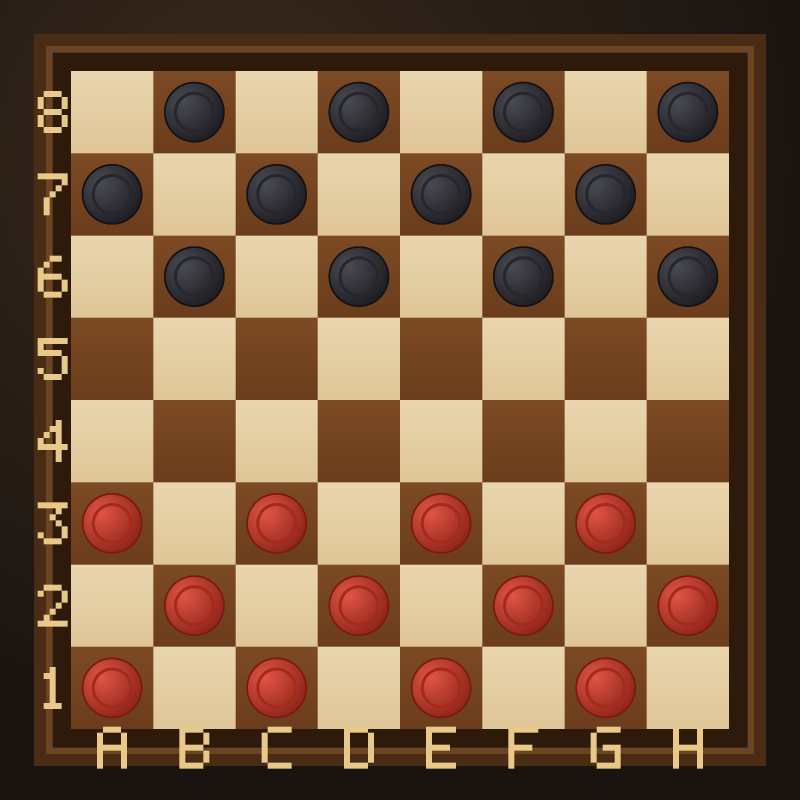
Set-up in one line for each side:
- Red fills the dark squares of the bottom three rows (ranks 1–3) and moves up the board.
- Black fills the dark squares of the top three rows (ranks 6–8) and moves down the board.
- The two middle rows (ranks 4 and 5) start empty — that is the no-man's-land where the first contact happens.
How the pieces move
An ordinary piece (a "man") moves one square diagonally forward onto an empty dark square — forward meaning toward the opponent's side. Red men move up the board; Black men move down. Men can never move straight, sideways, or backward (only kings can go backward — see below).
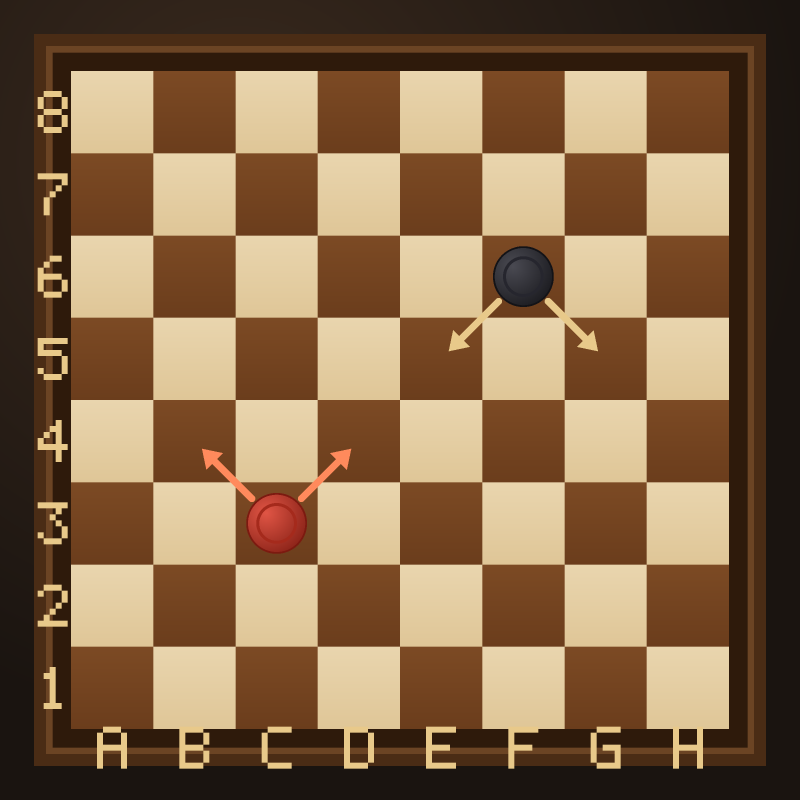
If a square is empty and diagonally forward, you may move there. If it is blocked by another piece — yours or the opponent's — you cannot simply move onto it. But if an enemy piece is directly in front of you with an empty square beyond it, something more important happens: you must capture it.
Capturing: jumps are forced
To capture, you jump diagonally over an adjacent enemy piece and land on the empty square immediately beyond it. The jumped piece is removed from the board. A single jump moves you two squares in a straight diagonal line.
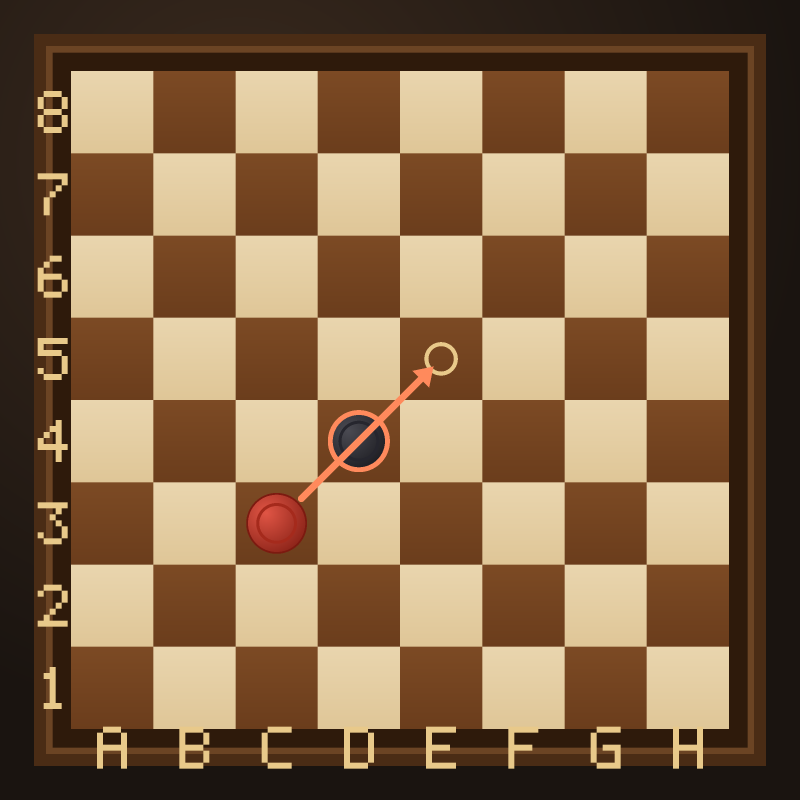
The single most important rule in checkers: if you can capture, you must. Captures are compulsory. You are not allowed to make a quiet move while a jump is available — you have to take the jump. If two different captures are on offer, you may choose which one to make, but you cannot decline capturing altogether.
Multiple jumps in one turn
A capture can chain. If, after landing from a jump, the same piece can immediately jump another enemy piece, it must continue jumping — all as a single turn. One move can sweep two, three, or more of the opponent's pieces off the board.
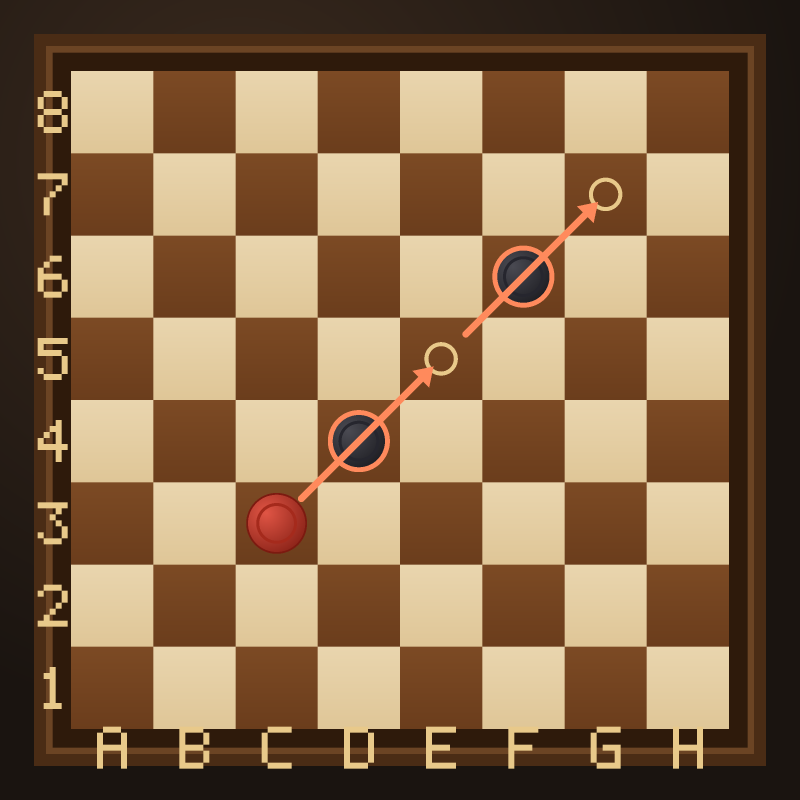
Because chained jumps must be completed, a tempting-looking capture can lead you straight into a trap, and a quiet-looking position can hide a double or triple jump. Always look at the whole chain — yours and your opponent's — before you commit.
Kings and crowning
When one of your men reaches the far row — the opponent's back rank, called the king row — it is crowned and becomes a king. A king is more powerful: it can move and capture diagonally in all four directions, forward and backward.
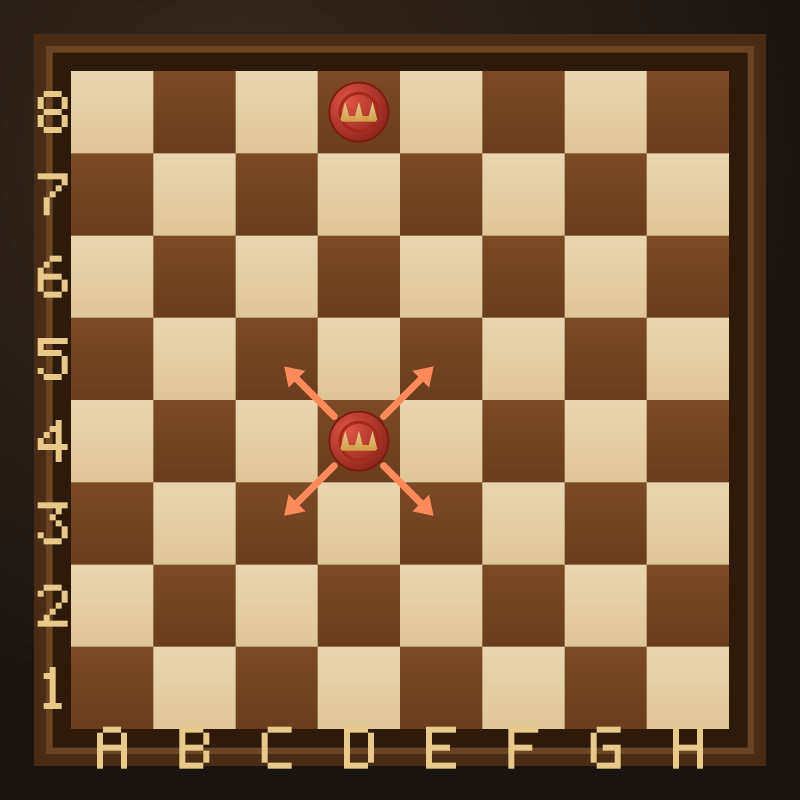
A few important details about crowning:
- Reaching the king row ends your turn. A freshly crowned king does not keep jumping as a new king on the same move.
- In English draughts a king still moves and jumps one square at a time — it does not fly long distances across empty squares (that is a different variant, international draughts).
- Kings are your best pieces. Getting the first king is often a real advantage, because it can chase and capture pieces that ordinary men cannot reach.
How to win (and draws)
You win the game if your opponent:
- has no pieces left on the board, or
- still has pieces but is completely blocked — it is their turn and they have no legal move.
Sometimes neither side can force a win — for example when both players are down to a couple of kings that simply chase each other. That is a draw. On Checkers Arena either player can offer a draw at any time, and the server also declares a draw automatically on threefold repetition or after 40 moves with no capture and no man advancing — so a dead-drawn game can't drag on forever.
Fair play on Checkers Arena
Every rule on this page is enforced by the server, not just the browser, so a game is always legal and fair for both sides:
- Every move is validated against the same rules engine before it is accepted — an illegal move simply cannot be played, by you or your opponent.
- Forced captures are enforced. When a jump is available, only jumping moves are offered, and a multi-jump must be finished.
- The move clock is server-authoritative. Each turn has a time limit that runs on the server, so no one can stall a game indefinitely.
- Play the computer or a real person. Face the AI on three difficulty levels, challenge a friend over a private link, or get matched with a random opponent — all free, with no signup required.
Strategy for beginners
Checkers is far deeper than it first looks. A handful of principles will take a beginner a long way:
- Control the centre. Pieces in the middle of the board have more squares to move and attack from; pieces stuck on the edges have fewer options and are easier to trap.
- Hold your back row. Keeping pieces on your own king row stops the opponent from crowning a king there. Give it up carefully, not casually.
- Trade when you are ahead. If you have captured more pieces, swapping pieces one-for-one simplifies the game and makes your material lead decisive. Avoid trades when you are behind.
- Race for the first king. A king's ability to move backward is a big edge in the endgame. Push a piece toward the king row when the path is safe.
- Count the whole jump before you take it. Because captures are forced and chain, look at what your move lets the opponent do next. A "free" piece is often bait for a bigger multi-jump.
- Keep pieces connected. Pieces that protect each other are hard to attack — if an enemy jumps one, you recapture. Lone pieces on empty squares are targets.
Common beginner mistakes
- Moving without checking for jumps. Always ask "can anything be captured?" — for both sides — before you move.
- Grabbing every piece on offer. A forced capture can drag your piece into a losing multi-jump. Sometimes the whole point of a sacrifice is that you have to take it.
- Breaking the back row too early. Once you move those pieces, the opponent has a lane to crown a king.
- Pushing pieces to the edges. Edge pieces can't be jumped from one side, but they also have far fewer moves — you can get boxed in.
- Trading while behind. Swapping pieces helps the player who is ahead. If you are down material, keep pieces on the board and play for a trap or a draw.
Glossary of terms
- Man: an ordinary (un-crowned) piece. Moves one square diagonally forward.
- King: a crowned piece that moves and captures in all four diagonal directions.
- King row: the far back row where a man is crowned into a king.
- Jump / capture: hopping diagonally over an adjacent enemy piece to remove it.
- Forced capture: the rule that you must jump whenever a jump is available.
- Multi-jump: a chain of jumps by one piece in a single turn.
- Trade: a one-for-one exchange of pieces.
- Blocked: having no legal move — which loses the game.
- Draughts: the name for checkers used in Britain and much of the world.
Ready to play?
The fastest way to learn is to play. On Checkers Arena the board highlights your legal moves, enforces forced captures, and lets you play the computer on three levels or a friend over a private link — all free, with no signup.
▶ Play checkers nowPrefer a concise reference? See the complete checkers rules, or sharpen your play with the strategy guide.
Prefer a real board? Print one: printable checkers board — board, cut-out pieces and one-page rules.
← Back to the game