Play Brazilian Draughts Online
Play free online vs the computer or a friend — 8×8 board, international rules
Esta página em português: Damas brasileiras — jogue de graça
Brazilian draughts (Portuguese jogo de damas) is one of the world's most popular checkers variants. It is played on the same 8×8 board as American checkers, but with the international rules: men capture forward and backward, kings fly across the board, and you must always take the maximum capture. Play it free against the computer, right in your browser — no signup.
▶ Play Brazilian Draughts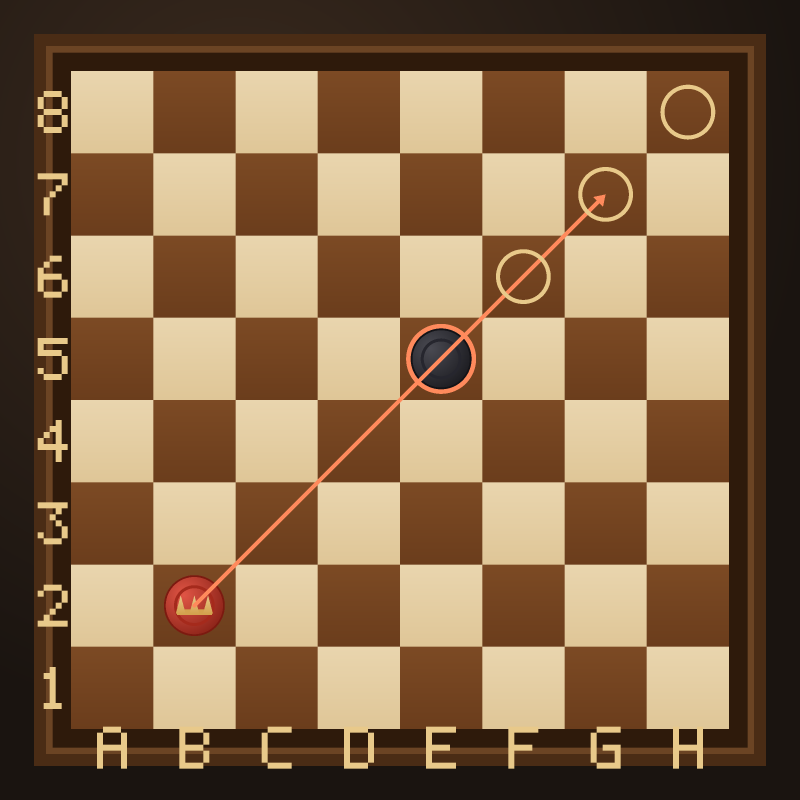
Play Brazilian draughts vs the computer
Start a game right now — free, no signup, nothing to download. Brazilian draughts runs in your browser against a computer opponent on three levels: Easy, Medium and Hard. The board highlights every legal move, glows the pieces that must capture, and enforces the maximum-capture rule for you, so you can learn the game by playing it rather than by reading about it first.
▶ Play Brazilian Draughts vs the computerPlaying online against people
You can play Brazilian draughts online against another person, and there are three ways in. None of them needs an account:
- Invite a friend — the Invite a Friend button makes a private link. Send it, the other person opens it, and you are playing. The link carries the variant with it, so Brazilian stays Brazilian.
- The lobby — Find Opponent shows who is on the site right now and who is waiting for a game. You can challenge anyone listed, and every waiting challenge says which variant it is for.
- An open challenge — post one and close the tab. When somebody accepts, the game is waiting for you when you come back.
Online games count towards your Elo rating, which starts at 1200. All four variants share one rating rather than four thin ones — see how the site works. And when nobody is around, the computer opponent gives you a strong game at any hour.
What makes Brazilian draughts special
If you already know American checkers, Brazilian draughts will feel familiar for about one move — then the differences change everything. Three rules give the game its character:
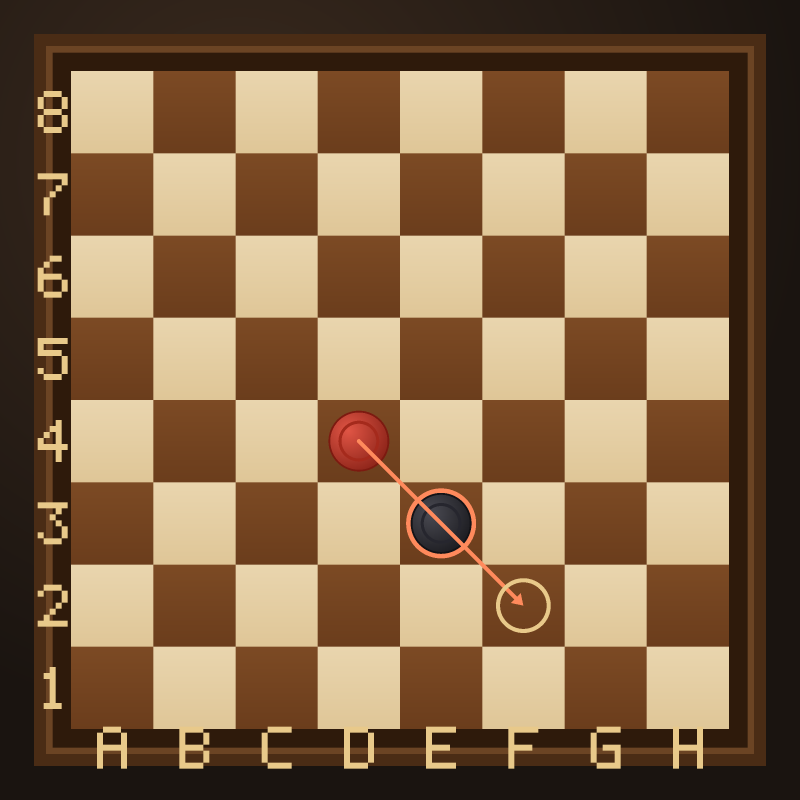
- Men capture backward. An ordinary piece still moves only forward, but it may jump an enemy in any diagonal direction — including behind it. Sudden reversals are everywhere.
- Kings fly. A crowned king slides any distance along a diagonal and captures from far away, landing on any empty square beyond its victim. A single king can dominate a whole board.
- Maximum capture is compulsory. When several captures are available you must play the one that takes the most pieces — so long combinations are forced, not optional.
The rules in brief
Enough to start a game right now. The complete rules cover every case.
- Board and setup. 8×8, dark squares only, twelve pieces each on the three nearest rows. The two middle rows start empty.
- Moving. A man moves one square diagonally forward onto an empty dark square. It never moves backward — but it captures backward.
- Capturing is compulsory, and among the available captures you must take the one that removes the most pieces. Captured pieces come off only once the whole sequence is finished, and the same piece may never be jumped twice.
- Kings fly any distance along a diagonal, and capture from a distance — provided nothing stands between king and victim, and at least one square beyond the victim is free.
- Promotion happens when a move ends on the far row. A man that merely passes through it mid-capture stays a man.
Brazilian draughts strategy — five ideas that win games
The three rule differences are not decoration; they change what a good move looks like. If you arrive from American checkers, these five are where the transfer breaks down.
1. The race to crown decides more games than material
A flying king here is not "a piece that can also go backward" — it is a piece that controls an entire diagonal and captures from the far end of it. Being a piece down with the first king is frequently better than being a piece up without one. When you weigh a trade, count kings first and pieces second.
2. Compulsory maximum capture is a weapon, not a rule you obey
Because your opponent must take the longest capture available, you can decide their reply for them. Offering a piece does not ask them whether they want it — it removes every other option they had. Nearly every combination in this game begins with a deliberate sacrifice that forces a specific recapture.
3. No piece is safe from behind
Backward captures mean a man that has passed your line is still dangerous, and a piece you have "gone around" can still be taken. Before every move, check the diagonals behind your pieces as well as in front of them. This is the single most common way players coming from American checkers lose material.
4. Count the whole chain before you take
A capture that wins three pieces is worthless if the recapture wins four. With maximum capture forced, sequences run long, and the position after them can look nothing like the position you calculated from. Play the whole chain out in your head — including their answer — before you commit.
5. Keep your back row honest
The pieces on your own king row cost nothing to leave where they are, and while they stand, the opponent cannot crown behind them. Given how much a flying king is worth, delaying the opponent's first king is often worth more than an extra man somewhere else.
Want to see whether a plan actually worked? Replay the position on the analysis board, or compare the variants side by side on the differences page.
Frequently asked questions
What is Brazilian draughts? A checkers variant on an 8×8 board with international rules — backward captures, flying kings and compulsory maximum capture.
How is Brazilian draughts different from American checkers? Same 8×8 board, different rules. In American checkers men capture forward only and kings move one square; in Brazilian draughts men capture in all four directions, kings are flying (long-range), and the maximum-capture rule is compulsory.
Is Brazilian draughts the same as international draughts? Same rules, different board: international draughts uses a 10×10 board with 20 pieces per side; Brazilian uses 8×8 with 12 pieces. See the differences page for a full comparison.
Can I play Brazilian draughts online for free? Yes — free in your browser with no signup, against the computer on three levels or against another person.
Why is it called Brazilian draughts? Because of where the combination came from, not the rules. Players in Brazil took the rules of the 10×10 international game and put them on the 8×8 board that was actually available — a chessboard. The variant took shape in the 1930s and is now the standard game across Brazil and much of Latin America. The history page tells it properly.
Is Brazilian draughts harder than American checkers? Sharper rather than harder. The board is the same size, but backward captures and flying kings mean far more of the position is live at any moment, and compulsory maximum capture makes combinations longer. Beginners lose pieces to captures from behind; that is the adjustment to make first.
Can a man capture a king? Yes. Nothing on the board is protected from capture — an ordinary man may jump a king, in any diagonal direction. Being crowned buys movement, never immunity.
More questions? See the full Brazilian draughts FAQ.
Start playing
The rules click into place once you play. Open the board with Brazilian preselected and try a game — the flying kings alone are worth it.
▶ Play Brazilian Draughts nowNew to checkers in general? Start with our how-to-play guide and the American checkers rules.
Esta página em português: Damas Brasileiras · Regras das damas.
← Back to the game