Play International Draughts Online
Play free online vs the computer or a friend — the 10×10 tournament game
Ta strona po polsku: Warcaby online — graj za darmo
International draughts (also called Polish draughts) is the big one: a 10×10 board, 20 pieces per side, and the full international rules — men capture forward and backward, kings fly, and you must always take the maximum capture. It is the tournament standard, governed worldwide by the FMJD. Play it free in your browser — against the computer or against another person on a link you send, no signup.
▶ Play International Draughts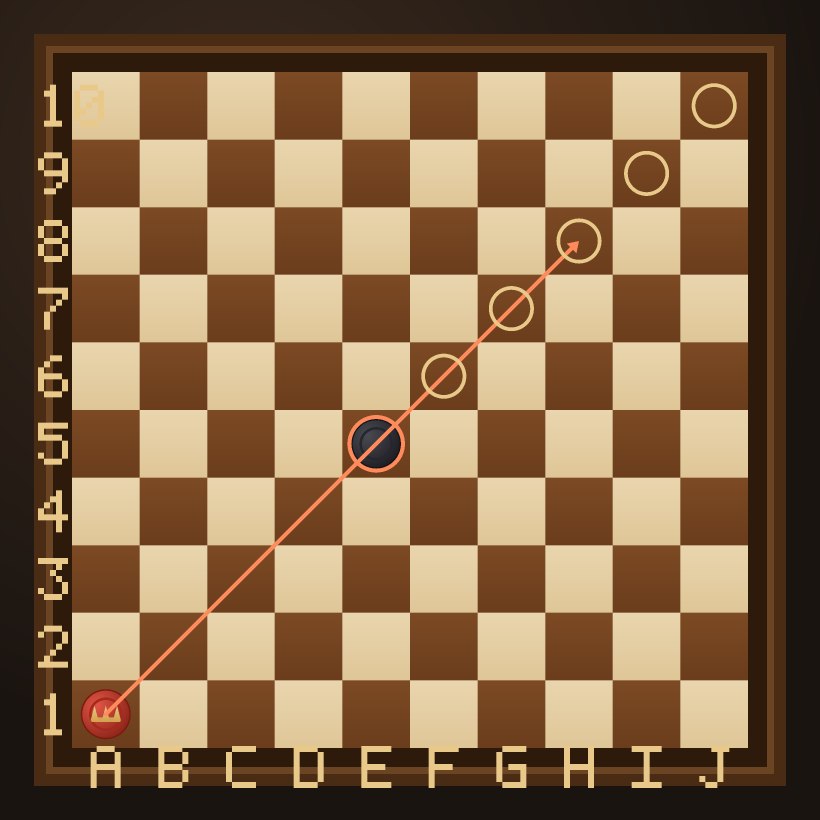
Play international draughts vs the computer
Start a game right now — free, no signup, nothing to download. International draughts runs in your browser against a computer opponent on three levels: Easy, Medium and Hard. The board highlights every legal move, enforces the maximum-capture rule, and animates each multi-piece capture along its path, so you can learn the game by playing it rather than by reading about it first.
▶ Play International Draughts vs the computerPlaying online against people
You can play international draughts online against another person, and there are three ways in. None of them needs an account:
- Invite a friend — the Invite a Friend button makes a private link. Send it, the other person opens it, and you are playing. The link carries the variant with it, so the 10×10 board stays a 10×10 board.
- The lobby — Find Opponent shows who is on the site right now and who is waiting for a game. You can challenge anyone listed, and every waiting challenge says which variant it is for.
- An open challenge — post one and close the tab. When somebody accepts, the game is waiting for you when you come back.
Online games count towards your Elo rating, which starts at 1200. All four variants share one rating rather than four thin ones — see how the site works. An account is free and optional; it carries your rating and friends list from one browser to the next.
What makes international draughts special
International draughts takes the sharp international rules and gives them room to breathe on a 100-square board. The extra space rewards deep calculation: combinations run longer, flying kings sweep across greater distances, and the maximum-capture rule forces spectacular multi-piece captures.
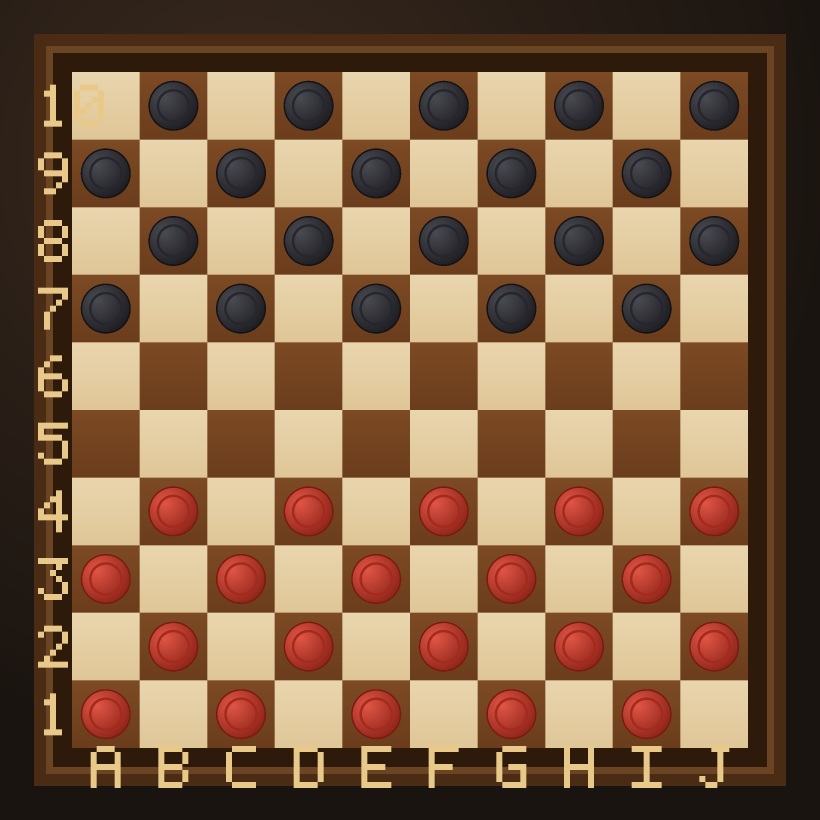
- A bigger board. 10×10 with 20 pieces per side — nearly double the material of the 8×8 games, and far more room to manoeuvre.
- Backward captures & flying kings. Just like Brazilian draughts, men jump in all four directions and kings travel any distance along a diagonal.
- Maximum capture is compulsory. When several captures are available you must play the longest one — the source of the game's famous long combinations.
The rules in brief
Enough to start playing. The complete rules cover every case.
- Board and setup. 10×10, dark squares only, twenty pieces each on the four nearest rows. The two middle rows start empty.
- Moving. A man moves one square diagonally forward. It never moves backward — but it captures backward.
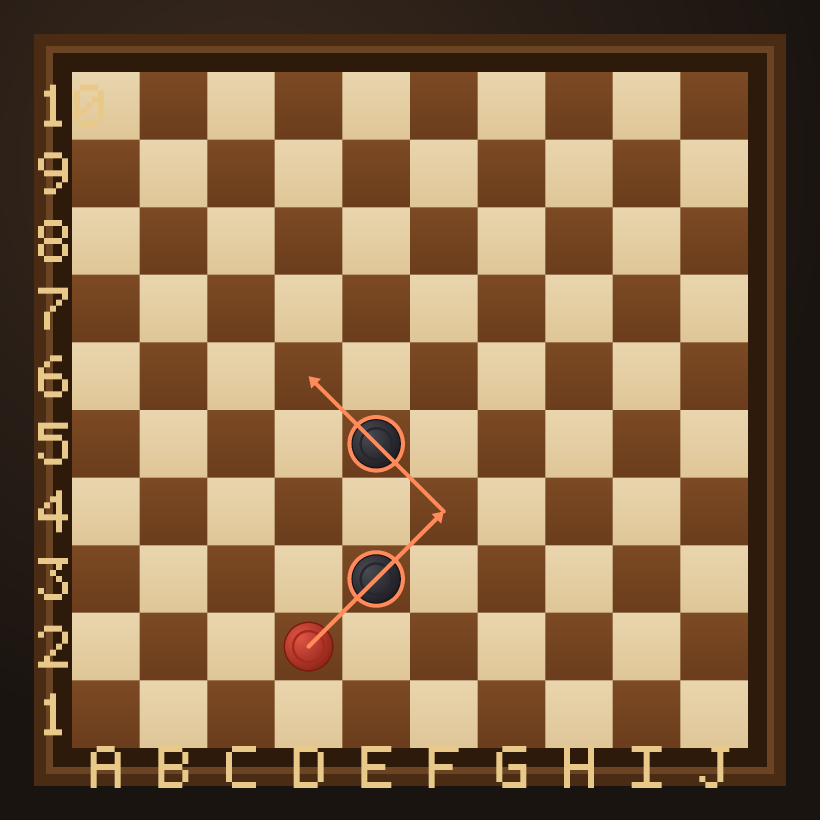
- Capturing is compulsory, and you must take the capture that removes the most pieces. Captured pieces stay on the board until the sequence ends, and the same piece may never be jumped twice.
- Kings fly any distance along a diagonal and capture from a distance — provided nothing stands between king and victim, and at least one square beyond it is free.
- Promotion happens when a move ends on the far row. Passing through it mid-capture does not crown the piece.
International draughts strategy — what the bigger board changes
The rules are identical to Brazilian draughts; the board is not. A hundred squares and forty pieces change which ideas actually matter.
1. Combinations run far longer — and so must your calculation
With compulsory maximum capture and four extra files to cross, capture chains of four, five or six pieces are routine rather than remarkable. The practical consequence is uncomfortable: a capture that looks winning three jumps in can be losing by jump six. Play the sequence to its end, then play the reply, before you commit to the first jump.
2. Formations matter more than individual pieces
With twenty pieces a side, single men are rarely decisive; groups are. Pieces that defend one another are hard to attack profitably, and a rigid wall of your own men can be as much a liability as an asset — it has nowhere to go. Aim for a structure that can still advance.
3. The centre is worth more here, not less
A larger board might suggest the edges are safer. The opposite holds: an edge piece on a 10×10 board is even further from the action, and a man that drifts to the rim can spend the entire game walking back. Contest the middle files early.
4. Tempo — count who runs out of quiet moves first
Because captures are compulsory, being forced to move can be as bad as losing a piece. In closed positions the player who runs out of harmless moves must open something up, usually to their cost. Serious players count this deliberately; it is the idea most beginners have never heard of.
5. A flying king on an open 10×10 board is enormous
The same king that is strong in the 8×8 game is stronger here, because the diagonals it commands are longer. Late in the game, one king against several men is often winning rather than merely holding. This is what makes the crowning race worth a sacrifice.
To check whether an idea really worked, replay the position on the analysis board, or see how the variants line up on the differences page.
Frequently asked questions
What is international draughts? A checkers variant on a 10×10 board with 20 pieces per side, using the international rules — backward captures, flying kings and compulsory maximum capture.
How is international draughts different from Brazilian draughts? Same rules, bigger board: Brazilian is 8×8 with 12 pieces, international is 10×10 with 20. See the differences page.
How big is the international draughts board? It is a 10×10 board of 100 squares. Play is on the dark squares only, with 20 pieces per player set up on the four nearest rows.
Can I play international draughts online for free? Yes — free in your browser with no signup, against the computer on three levels or against another person.
Why is international draughts also called Polish draughts? The French named it. The 100-square version took shape in France in the first half of the 18th century, but was known there as le jeu de dames à la polonaise — draughts in the Polish manner — and the first known publication about it, in 1740, was titled Coups de parties de Dames de la Polonoise. In Poland the game is called warcaby stupolowe, and we have a Polish version of this page.
Is international draughts harder than checkers? Deeper rather than harder to learn. The rules take five minutes; what takes time is calculating capture chains that run five or six jumps on a board with a hundred squares. It is the variant played at world-championship level, governed by the FMJD.
How do I get better at international draughts? Three habits do most of the work: calculate every capture chain to its end including the reply, contest the centre files early, and treat the race to the first king as worth material. The strategy section above goes through them.
More questions? See the full international draughts FAQ.
Start playing
The 10×10 board looks daunting and plays beautifully. Open it with International preselected and try a game — the long flying-king combinations are the whole point.
▶ Play International Draughts nowPrefer a smaller board? Try Brazilian draughts (same rules, 8×8), or start with American checkers.
← Back to the game