Checkers Openings
All seven first moves, tested with an engine · Updated August 10, 2026
Checkers has a rich body of opening theory — whole books are written about the first few moves. You don't need any of that to start well: there are only seven legal first moves, and this guide shows each one in the board's own coordinates and in the 1–32 notation the books use. It also does something an openings guide can rarely do: instead of repeating the usual advice about playing the centre, we ran all seven through our own engine and printed what came back — and every position here opens on the checkers analysis board so you can carry on from it yourself. New to the game? Start with the how-to-play guide and the rules, then play free on Checkers Arena.
Why the opening matters
In the opening you are not trying to win material — that rarely happens by force this early. You are trying to develop your pieces toward the centre with good structure, so that when the first exchanges come you are the side with more mobility and a safer position. A weak opening move won't lose on the spot, but it can hand your opponent the centre and leave you cramped for the rest of the game.
How to read the notation
Checkers Arena labels the board a–h across the bottom and 1–8 up
the side, just like a chessboard. A move is written from-to: c3-d4
means "move the man on c3 to d4". Red sits at the bottom and moves up the board; Red moves first.
(Serious checkers literature uses numbered squares 1–32 instead, but the letter-number coordinates
here are easier to follow on the live board.)
That numbering is worth knowing, because every checkers book and every tournament record uses
it. The 32 dark squares are numbered 1 to 32 starting in the double corner on the first
player's right, so the four men who can move first sit on 9, 10, 11 and 12 —
g3, e3, c3 and a3 here. The famous
opening 11-15 — often nicknamed Old Faithful today, though not
by the players who named these lines a century ago — is therefore c3-d4: the central
advance this guide recommends. The table below gives both notations side by side.
The seven first moves
Only Red's four men on rank 3 — a3, c3, e3 and g3 — can move first, and between them they have exactly seven legal opening moves. The diagram shows all seven: the orange arrows are the central advances (to d4 or f4), the gold arrows are the moves to b4 or h4. That split is about geometry, not quality — as the engine section below shows, it does not predict which move is better.
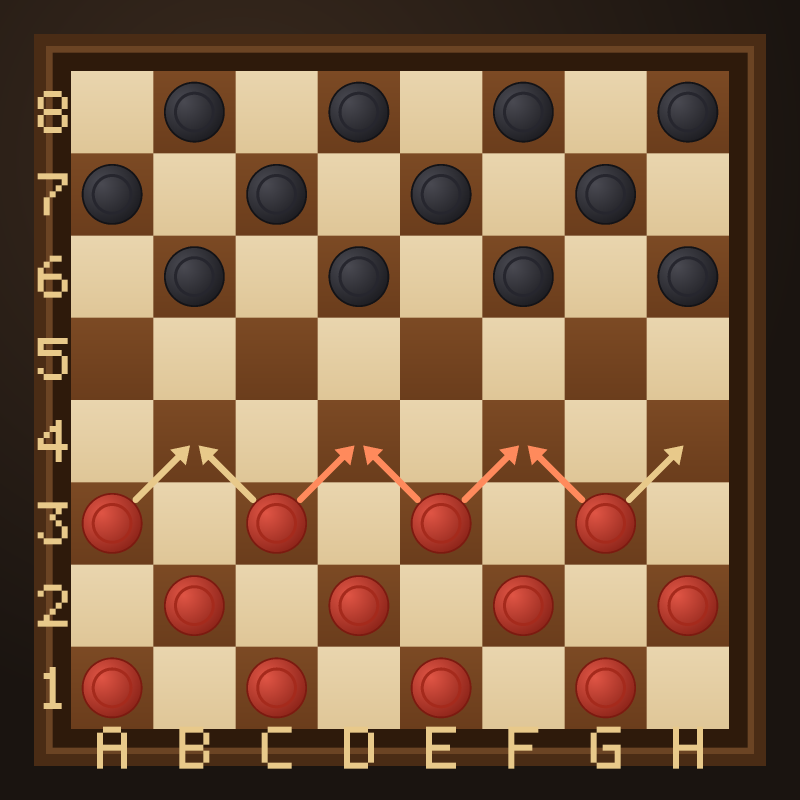
What is the best first move in checkers?
There isn't one, and that is a measurement rather than an opinion. We searched all seven of Red's opening moves with the Checkers Arena engine to a fixed depth of 14 half-moves. They came back within 4 points of each other on a scale where a single checker is worth 100 — far too close to call. Every one of them earns the same verdict from the engine: the position is about equal.
This is the expected answer, not a surprising one. Checkers was solved in 2007: Jonathan Schaeffer's team at the University of Alberta proved that with perfect play on both sides the game is a draw. No first move can win by force, because the starting position itself does not win by force. What an opening choice buys you is a type of middlegame, not an advantage.
That proof was built from the back of the board forward, on a database holding every position with ten pieces or fewer — 39 trillion of them. We ship the same idea at a smaller scale: our checkers endgame database holds all 6.4 million positions with four pieces or fewer, solved exactly, so the ending of a game can be looked up rather than calculated. Openings are where certainty runs out; endings are where it comes back.
The one thing that does deserve its reputation is c3-d4 — 11-15. Not
because it scores better in our search — it doesn't, see below — but because more has been written
about what follows it than any other first move. We counted: in Richard Pask's published index to
all 156 tournament ballots, lines starting 11-15 are cited an average of
10.8 times each across his lessons, against 6.8–9.3 for the other six starts. The
single most-annotated ballot in the whole book — 11-15 23-19 8-11, the family behind
Old Fourteenth, Glasgow, Laird and Lady and half a dozen other named openings — is cited 29 times.
If you want one opening to know well, that is the sensible one to pick: not because the engine
prefers it, but because a century of analysis has already mapped where it leads.
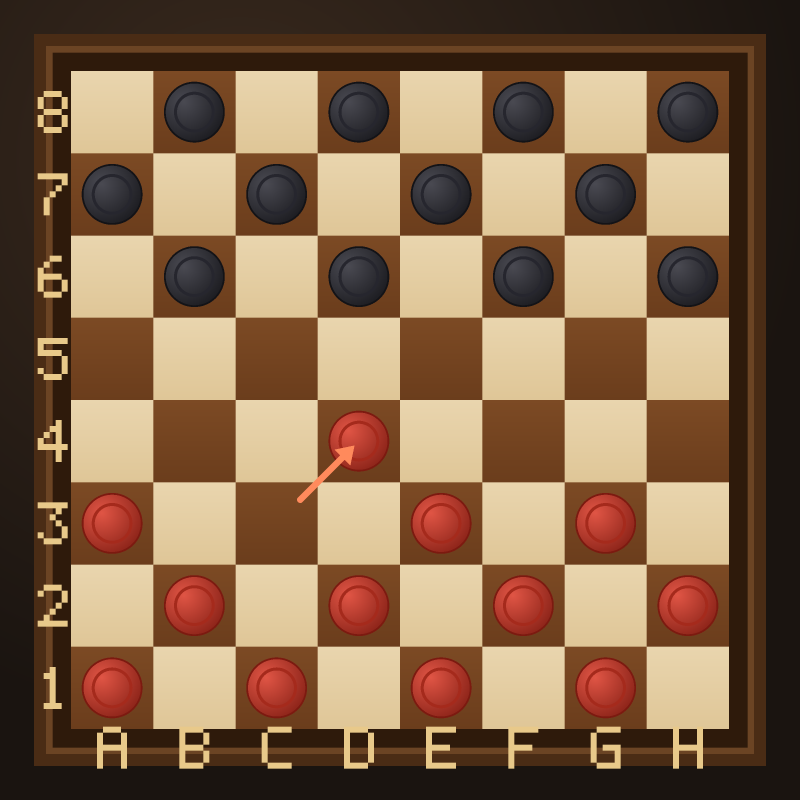
1. c3-d4 — 11-15: a man steps into the centre. The best-documented opening in the books, and level according to the engine, like the other six. Open this position on the analysis board.What the engine found at depth 14
Here is exactly what we did, so you can repeat it. Each of the seven moves is played on the starting board, and the resulting position is searched with Black to move; the number in the table is that result seen from Red's side. The search runs to a fixed depth rather than for a fixed number of seconds — our analysis board deliberately searches to the clock, which means a faster computer looks further and can change its mind, and numbers printed in an article must not depend on the machine that produced them.
| Move | In books | Engine (Red) | Black's best reply | Position |
|---|---|---|---|---|
c3-b4 | 11-16 | +3 | f6-g5 | Open |
a3-b4 | 12-16 | +1 | b6-a5 | Open |
c3-d4 | 11-15 | +1 | f6-g5 | Open |
g3-f4 | 9-14 | +1 | f6-g5 | Open |
g3-h4 | 9-13 | +1 | b6-c5 | Open |
e3-f4 | 10-14 | 0 | f6-g5 | Open |
e3-d4 | 10-15 | −1 | h6-g5 | Open |
Four points from top to bottom. For comparison, winning a single man is worth 100 — so the whole spread between the "best" and "worst" opening in checkers is about four per cent of one piece.
The ranking will not sit still
The clearest evidence that these differences are noise is what happens when you search deeper. We ran the same seven moves at five depths. No two depths agree on the order, and the move at the top changes as well:
| Search depth | Engine's favourite | Spread | Order, best to worst |
|---|---|---|---|
| 6 half-moves | 11-16 | 3 | 11-16 · 11-15 · 9-13 · 10-15 · 12-16 · 10-14 · 9-14 |
| 8 half-moves | 11-15 | 4 | 11-15 · 10-14 · 12-16 · 11-16 · 10-15 · 9-14 · 9-13 |
| 10 half-moves | 11-16 | 10 | 11-16 · 9-14 · 12-16 · 9-13 · 11-15 · 10-15 · 10-14 |
| 12 half-moves | 11-16 | 6 | 11-16 · 11-15 · 9-14 · 9-13 · 12-16 · 10-14 · 10-15 |
| 14 half-moves | 11-16 | 4 | 11-16 · 12-16 · 11-15 · 9-14 · 9-13 · 10-14 · 10-15 |
A move that is second-best at one depth and second-worst at the next is not being evaluated — it is
being rounded. Notice too that 9-13 and 12-16, the two moves most guides
call weak, sit in the middle of the pack at every depth, while the central 10-15 is last
three times out of five. The engine gives no support at all to "central moves are stronger".
Honest about the limits: this shows that a 14-ply search with our evaluation cannot tell these moves apart. It does not prove they are equal. Real opening theory reaches far deeper than 14 half-moves, and the reasons the books prefer some of these are about the structures they lead to twenty moves later — which is exactly the sort of thing this kind of search cannot see.
What actually separates the seven
If the evaluation cannot separate them, something else has to, and one thing genuinely does — but it is only one of the seven moves, not the two usually named.
g3-h4 (9-13) is the one real outlier. It puts a man on the h-file, the
edge of the board, and a man there has only one square to advance to instead of two.
That is countable, not folklore: in the position after g3-h4 the man that just moved has
a single onward move; after any of the other six it has two. An edge man does half the work, and it is
harder to support and easier to shut out.
a3-b4 (12-16) is not that case, although it is often lumped in with it.
The man leaves the a-file and lands on b4, where it has two advances like any central man.
Whatever makes 12-16 less popular in the books, it is not a mobility problem, and nothing we can
measure here shows it. We would rather say that than repeat a tidy explanation that the board
contradicts.
Worth noting what does not differ: after every one of the seven first moves, Red has exactly eight legal moves available. No opening cramps you more than another at this stage.

1. g3-h4 — 9-13: the gold arrow is the move, the thin orange arrow is everything the man can do next. One square, where the other six first moves leave two. Open this position on the analysis board.All seven first moves at a glance
| Move | In books | Lands on | Onward moves | The idea |
|---|---|---|---|---|
c3-d4 | 11-15 | Centre | 2 | Old Faithful (a modern nickname) — the best-documented first move, cited far more often across published tournament theory than any other. |
e3-d4 | 10-15 | Centre | 2 | Occupies the same central square from the other side. |
e3-f4 | 10-14 | Centre | 2 | A central advance toward the kingside. |
g3-f4 | 9-14 | Centre | 2 | Brings a man into the centre-right. |
c3-b4 | 11-16 | Off-centre | 2 | Heads away from the middle but keeps both diagonals — the engine's mild favourite at four of five depths. |
a3-b4 | 12-16 | Off-centre | 2 | Takes the man off the a-file. Less popular in the books, though not for any reason visible on the board. |
g3-h4 | 9-13 | Edge | 1 | The only move that genuinely restricts its own man: on the h-file it has one advance instead of two. |
All seven are playable, and with best play checkers is a proven draw — none of these loses. If you
want one easy rule, it is narrower than the usual advice: everything is playable, but a man
on the edge file does half the work. Beyond that, pick an opening because you know what
follows it, which is the real argument for learning 11-15 first.
After the first move
Black has the same seven moves mirrored from the top of the board, and often replies symmetrically, matching your development. A few things to keep in mind once the pieces start to meet:
- Don't rush a capture. Because captures are forced, the first player to reach in can sometimes be steered into a bad trade. Develop first; take when the trade helps you.
- Keep your men supported. Advance so that a piece which gets jumped can be recaptured. A lone man poked into the centre is a target.
- Hold your back row for now — you rarely need those pieces in the opening, and they stop an early enemy king.
Opening principles
- Fight for the centre — from move two onward. Central control decides middlegames, but as the table above shows it does not make one first move better than another. Where it starts to matter is when the pieces meet.
- Don't park men on the a- or h-file without a reason. That is the one mobility cost you can count: an edge man has a single square to advance to instead of two.
- Develop with support, not lone runners that can be picked off.
- Keep your back row intact early to deny the opponent a quick king.
- Expect symmetry, and don't lash out with a premature capture that only helps your opponent.
- Play the whole board: a good opening flows straight into the middlegame ideas in our strategy guide.
Checkers openings: common questions
How many opening moves are there in checkers?
Exactly seven. Only the four men on Red's third rank — a3, c3, e3 and g3 — have anywhere to go, and between them they reach four squares: b4, d4, f4 and h4. Three of those can be entered from either side — b4 from a3 or c3, d4 from c3 or e3, f4 from e3 or g3 — while h4 can only be reached from g3. That is 2 + 2 + 2 + 1 = seven. Black then has exactly seven replies to each of them, so there are 49 possible two-move openings.
What does 11-15 mean in checkers?
It is the same move as c3-d4, written in the numbering used by every checkers book and
tournament record. The 32 dark squares are numbered 1 to 32 starting from the double corner on the
first player's right, so square 11 is c3 and square 15 is d4. It is often nicknamed Old
Faithful today, but that name is modern: it does not appear in W. T. Call's 1909
Vocabulary of Checkers, which does record dozens of other opening names from the same
period. Both notations appear side by side in the table above, because the coordinates are easier to
follow on a board and the numbers are what you will meet in the literature.
Are central openings stronger in checkers?
Not measurably. Searched to 14 half-moves, the four central advances average the same score as the
three that go to b4 or h4 — and at every depth we tried, the engine's favourite was
11-16, which is not a central move at all. Central control decides middlegames, but it
does not make one first move better than another. The one difference that does survive counting is
mobility on the edge file, and that affects a single opening, 9-13.
Practise the openings
The best way to learn the openings is to play them. On Checkers Arena the board highlights every legal move, so you can try each first move and see how the game develops — against the computer on three levels, or against friends and online opponents, free with no signup.
▶ Play checkers nowMore: the how-to-play guide, the complete rules, and the strategy guide.
← Back to the game