Brazilian Draughts Rules
The complete rules of damas on an 8×8 board · Updated August 9, 2026
Esta página em português: Regras das damas brasileiras
This is the complete rule set for Brazilian draughts (jogo de damas) as played on Checkers Arena. It uses the international rules on an 8×8 board. If you know American checkers, focus on three things that differ: men capture backward, kings fly, and you must take the maximum capture. When you are ready, play free vs the computer.
Objective
Brazilian draughts is a game for two players. Each starts with twelve pieces. You win by capturing all of your opponent's pieces, or by leaving them with no legal move.
The board and setup
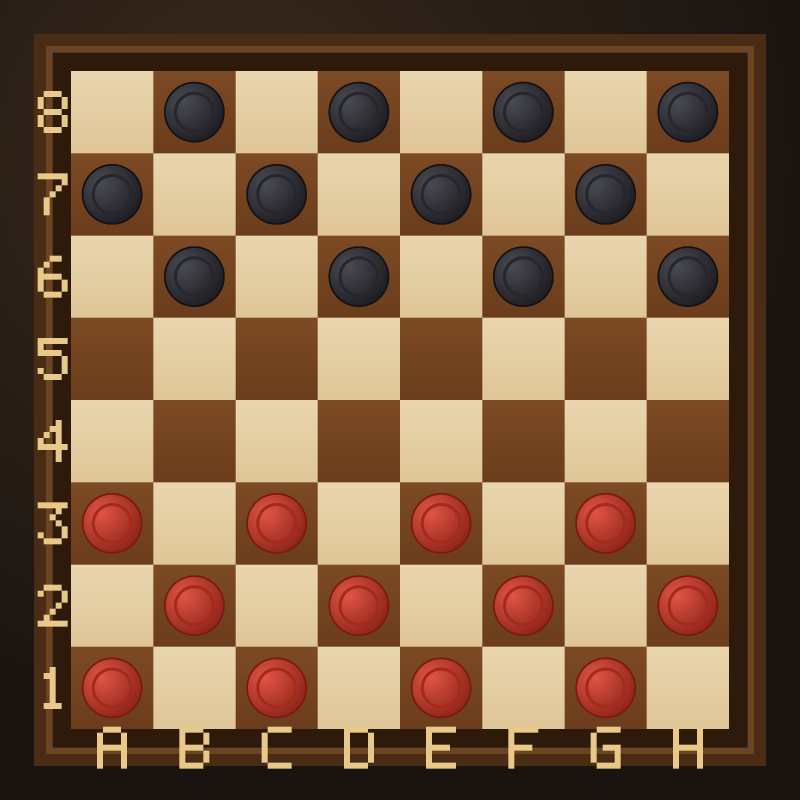
The game is played on an 8×8 board of 64 squares, using the dark squares only — every move is diagonal. Each player places twelve pieces on the dark squares of their three nearest rows; the two middle rows start empty. The starting position is identical to American checkers.
Moving the pieces
- An ordinary piece (a man) moves one square diagonally forward to an empty dark square — forward means toward the opponent's side.
- Men move forward only. (They may capture backward — see below — but a non-capturing move is always forward.)
- A king moves any number of empty squares along a diagonal — see flying kings.
Capturing — and backward captures
- You capture by jumping diagonally over an adjacent enemy piece onto the empty square immediately beyond it. The jumped piece is removed.
- Crucially, a man may capture in any diagonal direction — forward or backward. This is the biggest day-to-day difference from American checkers, where men capture forward only.
- Captures are compulsory. If a capture is available you must take it; you may not make a quiet move instead.
- A capture that can continue must continue: the same piece keeps jumping in the same turn until no further jump is possible (a multi-capture).
- Captured pieces are removed only at the end of the move, and a piece may not be jumped twice in the same sequence.
The maximum-capture rule
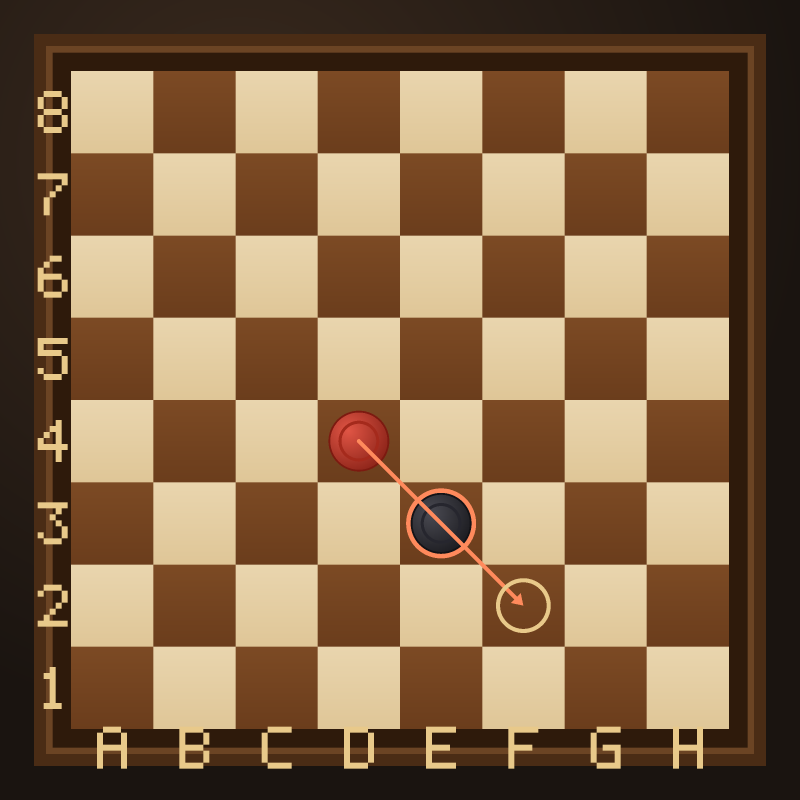
When more than one capturing sequence is available, you must play the one that captures the greatest number of pieces. You do not get to choose a shorter capture to keep a nicer position — the longest line is compulsory. (If two different lines each take the maximum number, you may choose between them.)
Flying kings
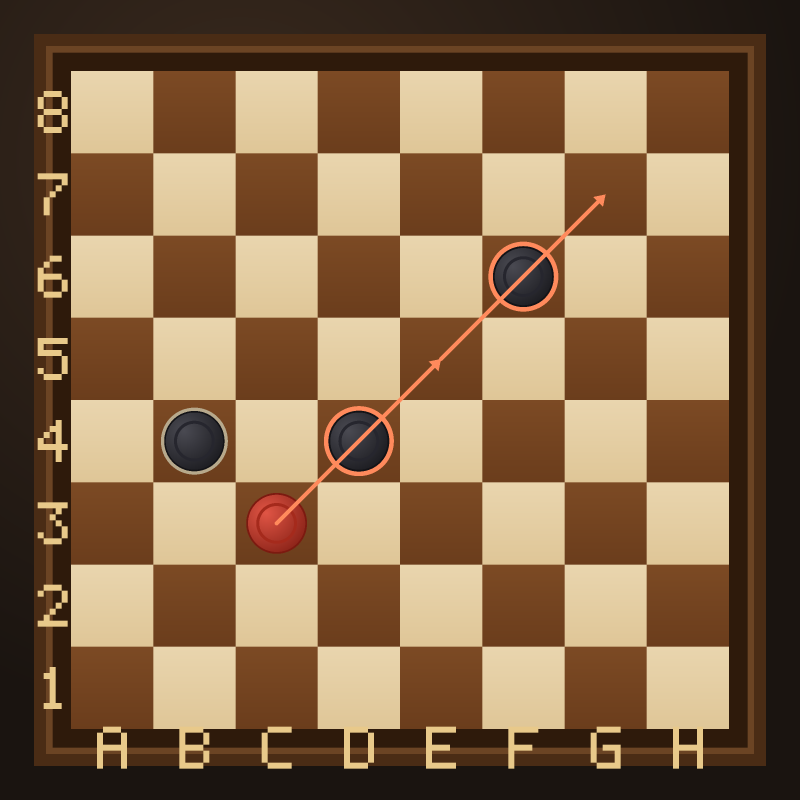
When a man reaches the far row it is crowned and becomes a king (a dama). Unlike an American king, a Brazilian king flies: it moves any number of empty squares along a diagonal, in all four directions. It captures the same way — jumping an enemy piece from a distance and landing on any empty square beyond it. A single flying king is powerful enough to control the whole board.
Promotion
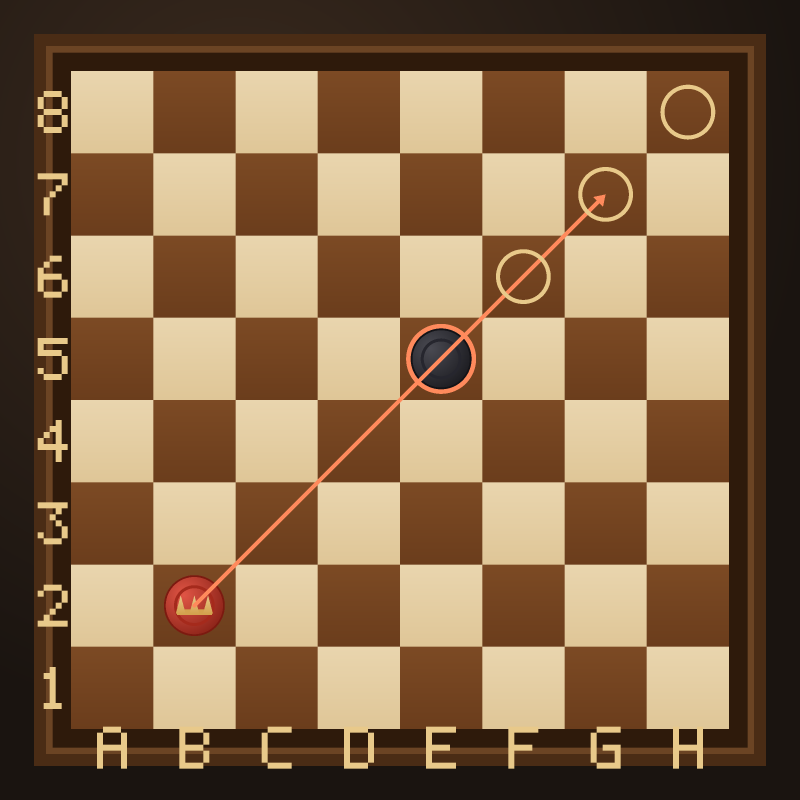
A man is crowned when it finishes its move on the far row. There is one subtlety worth knowing: if a man only passes across the far row in the middle of a capture and continues on, it is not crowned — promotion happens only when the last row is the final landing square. A newly crowned king does not keep jumping on the same turn.
Winning and draws
You win if your opponent has no pieces left, or still has pieces but cannot make a legal move. A game can end in a draw by agreement, by threefold repetition of a position, or after a long run with no capture and no man advancing — the same safeguards Checkers Arena uses to stop dead positions dragging on.
Quick summary
- Two players, twelve pieces each, on the dark squares of an 8×8 board.
- Men move one square diagonally forward, but capture in all four directions.
- Captures are compulsory and you must take the maximum number of pieces.
- Kings fly: any distance along a diagonal, capturing from afar.
- Reach the far row (and stop there) to be crowned. Win by capturing everything or blocking all moves.
Start playing
The board on Checkers Arena enforces every one of these rules for you — it highlights legal moves, glows the pieces that must capture, and forces the maximum-capture rule — so the fastest way to learn is to play.
▶ Play Brazilian Draughts nowNext: see how it stacks up against other variants on the differences page, or read the FAQ. Back to the Brazilian draughts hub.
Esta página em português: Regras das damas brasileiras.
← Back to Brazilian draughts