The Longest Jump in Checkers
Nine pieces in a single turn — the position, and why ten cannot exist · Updated October 31, 2026
A checkers capture does not stop at one piece. The jumping piece carries on from wherever it lands for as long as another jump is available, so a double, a triple and a nine-fold jump are all one move. The question is where that stops, and the answer on an 8×8 board is nine. Below is a legal position that takes nine, replayable jump by jump, and an argument that ten is not merely unseen but impossible.
The nine-capture position
- Pieces captured
- —
- Separate jumps
- —
- Legal moves for Red
- —
- The move
- —
- Notation so far
- —
Position code R4bbb5bbb5bbb8r —
open it on the analysis board
to pull it apart yourself.
The rule that makes long jumps possible
Three ordinary rules, stacked, produce the whole effect. First, a capture is made by jumping over an adjacent enemy piece onto the empty square directly beyond it. Second, if another jump is available from the square just landed on, the same piece must make it, and the turn does not pass until no jump remains. Third, each captured piece is taken off the board as it is jumped, which immediately frees the square it stood on.
That third rule is the one people are surprised by, and it is what allows a chain to double back through ground it has already crossed. In the position above the king lands on two squares twice — they were cleared earlier in the same move. The complete rules of checkers cover the basics; what matters here is only that the chain is a single move, so all nine pieces come off in one turn.
A chain also cannot jump the same piece twice. Without that restriction a king could shuttle back and forth over one unfortunate victim for ever, and the question of a longest jump would have no answer at all.
The nine-capture position, square by square
Using the standard numbering of the 32 dark squares — 1 to 4 along Black's back row, 29 to 32 along Red's — the position is as plain as it gets:
- Red king on 1, alone in the corner.
- Black men on 6, 7, 8 · 14, 15, 16 · 22, 23, 24 — three rows of three, a lattice with a gap on each side of every piece.
- Red to move, and it is Red's only move.
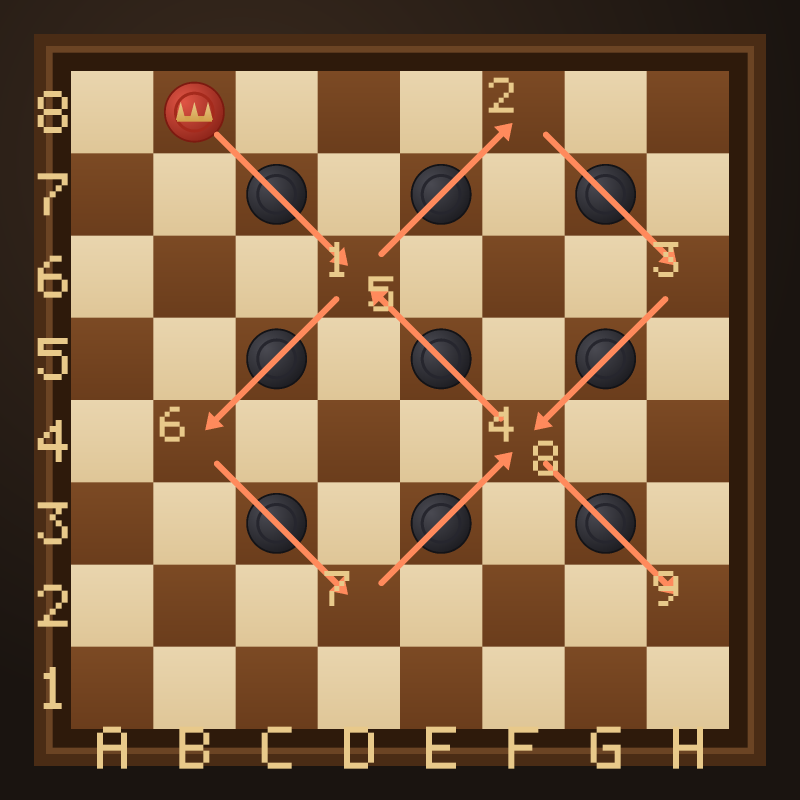
The jump runs —, taking the nine men in the order 6, 7, 8, 16, 15, 14, 22, 23, 24: along the first row, down and back along the second, down and forward along the third. It is a boustrophedon — the path a plough takes up and down a field — and that is not a coincidence. Turning at the end of a row is what lets the chain keep going instead of running off the edge.
Nine black men are on the board at the start and none at the end, so the move also wins the game on the spot. You can watch it a jump at a time with the second button, or take the position apart on the analysis board — move a single black man one square and the chain collapses, usually to three or four.
Why ten is impossible
It is easy to show that nine can be done — the board above does it. Showing that ten cannot is the harder half, and it is worth being precise about how far the argument reaches.
Strip the problem down to geometry. A jump is a move of two squares along a diagonal; a chain of n jumps is therefore a walk of n such steps that stays on the board, never jumps the same square twice, and never lands on a square still occupied. Every one of those conditions is a rule of the game, so every legal capture chain is one of these walks — but not every walk is a legal chain, because the game adds restrictions the walk does not care about. The set of walks is therefore larger than the set of legal chains.
Searching that larger set exhaustively — every dark starting square, every sequence of steps, with no piece limit and no colours — gives a longest walk of nine steps. Since the walks include every legal chain, nine is an upper bound on legal chains too. And nine is achieved by the legal position above. So the maximum is exactly nine, and the two halves of that proof share no reasoning: one is a search over geometry, the other a position the game engine plays out.
There is a shorter argument you will see quoted, and it is sound as far as it goes: a jump always moves between squares of the same colour-parity class, which splits the twelve enemy pieces into two groups and caps how many a single chain can reach. It explains why the number is small. It does not by itself pin it to nine rather than ten, which is why the search is here.
Why it has to be a king
A man captures too, and a man can chain captures. Two things stop it going far. A man only moves forwards, so its chain can never turn back along a row — and turning is exactly what the nine-jump path needs. And a man that lands on the far row is crowned there, which ends the turn immediately: a promotion in the middle of a chain cuts the chain off.
That second rule is worth stating carefully, because it is a real difference between variants. In American checkers crowning stops the move. In Turkish draughts it does not: a man that reaches the back row while capturing carries on as a man and only becomes a king once the move is over. Same situation, opposite outcome.
Nine is an American number
The figure belongs to 8×8 American checkers, with its specific board and its specific king. Change either and the ceiling moves:
- Brazilian draughts — the same 8×8 board, but kings fly any distance along a diagonal and men capture backwards as well. Longer chains, and the maximum capture is compulsory: where American rules let you choose between two captures, Brazilian rules make you take the bigger one.
- International draughts — 10×10, twenty pieces a side, flying kings. More board and more targets, so the ceiling is higher again.
- Turkish draughts — not diagonal at all. Pieces move and capture along rows and columns, which changes the geometry of a chain completely rather than merely enlarging it.
All four are playable here against the computer or against a friend, so the differences can be tried rather than taken on trust. The guides hub has the rules for each.
Would this ever happen in a game?
No. It needs nine enemy pieces arranged on an exact lattice with every landing square free — a formation no opponent would ever assemble, let alone leave standing. This is a constructed position in the tradition of chess problems: its value is that it marks the precise edge of a rule.
What does happen in real games is the two- and three-piece chain, and it decides games constantly. The useful habit is the one this position exaggerates: before moving, check what your move makes reachable, not just what it attacks. A shot that gives up one piece to take two is the most common winning idea in checkers — the strategy guide works through several, and the daily puzzle is usually one.
Common questions
What is the most pieces you can capture in one checkers move?
Nine. A king can chain jumps for as long as a jump is available, and on an 8×8 board the longest chain that geometry allows is nine jumps. The position on this page does exactly that, and the engine confirms it has only one legal move — so the nine captures are not merely possible there, they are forced.
Can you do a triple jump in checkers?
Yes, and there is no limit beyond what the board allows. A capture continues from the square the piece lands on for as long as another jump is there, so a double, triple or nine-fold jump is one single turn rather than several moves. In American checkers that chain must be taken once it starts: captures are compulsory.
Can a man do a multiple jump, or only a king?
A man can chain jumps too, but only forwards, and the chain ends the moment it lands on the back row because the man is crowned there and crowning ends the turn. That is why every long jump is a king's: a king captures in all four directions and never gets interrupted by its own promotion.
Why is ten captures impossible in checkers?
Because no chain of ten jumps fits on the board. A jump moves two squares diagonally, so a chain is a walk whose every step clears an occupied square and lands on an empty one, and no square may be jumped twice. Searching every starting square and every such walk exhaustively on an 8×8 board gives a longest chain of nine, which is an upper bound on the rules as well, since that search ignores several restrictions the rules add.
Do you have to take all nine pieces?
In American checkers you have to take the jump and you have to keep jumping while a jump exists, so a chain that starts cannot be abandoned halfway. What American rules do not require is picking the longest of several available captures: if two different chains are on offer, either may be chosen. Brazilian and international draughts do require the maximum capture.
Is a nine-capture position something that happens in a real game?
Essentially never. It needs nine enemy pieces standing on a precise lattice with every landing square free, which no player would walk into. It is a constructed position, in the tradition of chess problems, and its interest is that it marks the exact boundary of a rule rather than that it might occur over the board.
Try it on a real board
The quickest way to get a feel for chain captures is to be on the receiving end of one. Checkers Arena highlights every legal jump and enforces the compulsory-capture rule, so the chains announce themselves — against the computer on three levels, or against a friend on a link you send. Free, no signup.
▶ Play checkers nowNext: the complete rules of checkers, the questions people actually ask, or build a position of your own on the analysis board.
← Back to the game