How to Set Up a Checkers Board
Every piece, every square, and the corner people get wrong · Updated September 27, 2026
Setting up checkers takes about twenty seconds once you know the two things that are easy to get wrong: which way round the board goes, and which squares the pieces sit on. Both are settled below, with the starting position drawn live — and because the four draughts variants set up differently, you can switch between them and see the exact difference rather than read about it.
The starting position
Setting it up in four steps
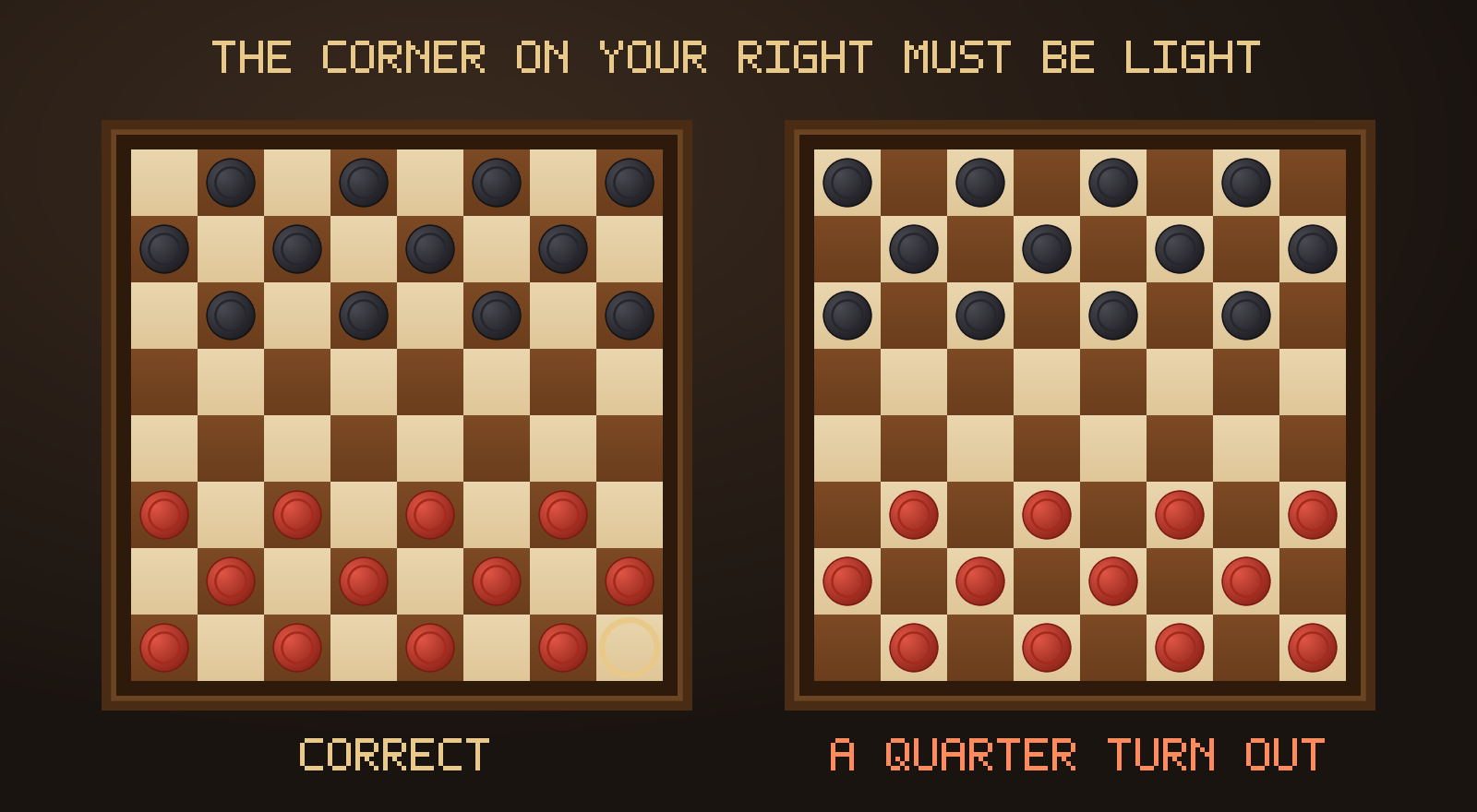
- Turn the board the right way round. Each player should have a light square in the corner nearest their right hand. If you have a dark square there, turn the board a quarter turn.
- Take twelve pieces each. A standard set has twelve a side — 24 in total on the board, with none held back.
- Fill the dark squares of your three nearest rows. Four dark squares per row, three rows, twelve pieces. Nothing goes on a light square.
- Leave the two middle rows empty. That gap is the no-man's-land where the first exchange happens. Then the darker set moves first.
Which way round the board goes
This is the step people skip, and it is the only one that can make everything after it wrong. A chequered board looks the same from all four sides, but it is not: rotate it a quarter turn and the dark squares land where the light ones were, so every piece would end up on the wrong colour.
The test takes a second. Sit at the board and look at the corner nearest your right hand: it should be light. The two dark squares beside it form what the rules call the double corner, and the American Checker Federation's Standard Laws put it on the player's right, with the single dark corner on their left. Because the board is symmetric, if it is right for you it is automatically right for your opponent — press See it from the other side above and the light corner stays on the right.
Why only half the squares are used
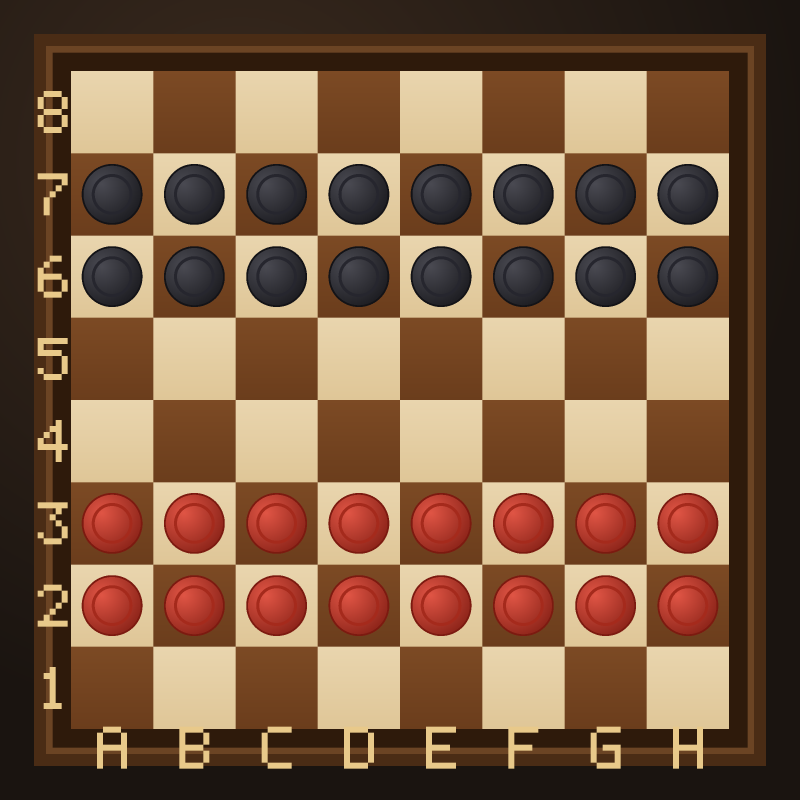
Checkers is played entirely on the dark squares — 32 of the 64. The reason is the move itself: pieces move diagonally, and a piece standing on a dark square can only ever reach other dark squares. The light half of the board is unreachable, so it is never used, and a piece placed there could not legally move at all.
That is also why a set has twelve pieces rather than sixteen: three rows of four dark squares. Count the diagram above and you will find exactly four pieces in each occupied row, staggered so that no two sit side by side.
One variant breaks this rule completely. Turkish draughts moves along rows and columns instead of diagonals, so it uses all 64 squares — switch the diagram to Turkish and the board fills up in a way that looks wrong until you remember that nothing in that game moves diagonally.
Colours and who moves first
The darker set moves first. Which colour that is depends on what you own: tournament pieces are red and white, while a shop set is usually red and black — which is exactly why books disagree, some saying "Red moves first" and others "Black moves first". They mean the same thing. On Checkers Arena Red always moves first and sits at the bottom of your screen, so the question never comes up.
Kings are made during the game, not at the start: every piece begins as an ordinary man. When one reaches the far row it is crowned, traditionally by stacking a captured piece on top of it — which is the other reason a set has pieces that stack. The complete rules of checkers cover crowning and the rest of the game.
The other variants set up differently
"Checkers" is a family, and the starting position is the first place the family splits. The diagram above draws each one from the same code the games themselves start from, so the differences below are exact rather than remembered:
| Variant | Board | Pieces each | Rows filled | Squares used |
|---|---|---|---|---|
| American (English draughts) | 8×8 | 12 | 3 nearest | dark only |
| Brazilian | 8×8 | 12 | 3 nearest | dark only |
| International | 10×10 | 20 | 4 nearest | dark only |
| Turkish (dama) | 8×8 | 16 | 2nd and 3rd | all 64 |
Two of those deserve a note. Brazilian draughts sets up identically to American — same board, same twelve pieces, same three rows — and then plays completely differently, because its men capture backwards and its kings fly. If you only ever see the starting position you cannot tell them apart, which is worth knowing before you agree to a game. Turkish draughts is the one that looks wrong: sixteen pieces a side packed onto two complete rows, with the back row left empty.
Four ways people get it wrong
- Board a quarter turn out. The pieces end up on the light squares. Check the corner on your right is light before you place anything.
- Pieces on the back row only two deep. It is three rows a side on an 8×8 board, not two — two rows is sixteen pieces, which is the Turkish setup, not this one.
- Filling the middle. Ranks 4 and 5 start empty. If your two armies are touching, someone has a row too many.
- Starting with kings. Every piece begins as a man. Kings are earned by reaching the far row.
Common questions
How do you set up a checkers board?
Turn the board so that each player has a light square in the corner nearest their right hand. Give each player twelve pieces and fill the dark squares of the three rows closest to them — four dark squares in each row, twelve in all. The two middle rows stay empty, and the darker set moves first.
Which way round does a checkers board go?
So that the corner square on each player's right is a light one. The two dark squares beside it form what the rules call the double corner, and the American Checker Federation's laws require it to be on the player's right; the single dark corner then sits on their left. Get this wrong and every piece ends up on the light squares instead.
Do checkers pieces go on the light or the dark squares?
On the dark squares, in every common variant except Turkish draughts. Because moves are diagonal, a piece on a dark square only ever reaches other dark squares, so half the board is never used. Turkish draughts is the exception: it moves along rows and columns instead of diagonals and uses all 64 squares.
How many pieces does each player get in checkers?
Twelve each on a standard 8×8 board, so 24 in total, filling the dark squares of three rows a side. Brazilian draughts uses the same twelve on the same 8×8 board. International draughts uses twenty a side on a 10×10 board, filling four rows. Turkish draughts uses sixteen a side on two full rows.
Which rows do the checkers go on?
The three rows nearest each player, leaving the two middle rows empty. On this site's coordinates Red fills ranks 1 to 3 and Black fills ranks 6 to 8, with ranks 4 and 5 empty — that gap is where the first contact happens. Turkish draughts is different again: its pieces go on the second and third rows, and the back row starts empty.
Who moves first in checkers?
The darker-coloured set moves first. Which colour that is depends on the set — tournament pieces are red and white, a shop set is usually red and black — which is why books disagree about the name. On Checkers Arena Red always moves first, so there is never an argument about it.
Board set up? Play a game
The quickest way to make the setup stick is to use it. On Checkers Arena the board starts itself, highlights every legal move and enforces the rules, so you can concentrate on the game — against the computer on three levels, or against a friend on a link you send. Free, no signup.
▶ Play checkers nowNext: the complete rules of checkers, the strategy guide, or set up a position of your own on the analysis board.
← Back to the game