Yes — weakly, since 2007. What that does and does not mean · Updated November 13, 2026
Yes. In 2007 the Chinook group at the University of Alberta proved that
American checkers, played perfectly by both sides from the standard opening, is a
draw. The word that carries all the weight is weakly: they produced a
strategy that can never lose from the starting position — not a verdict for every position that
could appear on a board. The difference is the whole subject of this page, and at the end of it
there is a corner of the solved game you can play out yourself, move by move.
The short answer, stated precisely
The claim published in Science on 14 September 2007, under the flat title
Checkers Is Solved, is this: there exists a strategy for American checkers that,
starting from the standard opening position, never loses — playing either
colour, against any opponent whatsoever. Since the same is true for the other side, neither
player can force a win, and the game-theoretic value of checkers is a draw.
That is a stronger statement than "a computer is very good at checkers" and a weaker one than
"every checkers position is understood". It is also, notably, not a surprise: strong players had
believed for decades that correct play draws. What 2007 added was a proof instead of a
conviction. If you are new to the game, the
complete rules of checkers are the place to start; this page
assumes you already know how the pieces move.
One piece of fine print that almost every retelling drops: the proof covers
go-as-you-please checkers, the version where both players choose their opening
moves freely. It settled nineteen different openings, all of them drawn. Serious tournament
checkers is usually played under the three-move ballot, where the first three moves are drawn
at random from a prescribed list precisely because free play is so drawish — and some of those
forced starts are not covered by the proof at all.
Weakly solved is not strongly solved
This is the distinction people arrive looking for, and it is worth getting exactly right.
Game theory uses three levels, and checkers sits in the middle one.
Level
What is known
Checkers
Ultra-weakly solved
The result of perfect play from the opening — but not how to achieve it.
Yes, as a consequence of the 2007 proof.
Weakly solved
A strategy that achieves that result from the opening, against any defence.
Yes — this is the 2007 result.
Strongly solved
The exact result for every legal position, however it arose.
No — only for positions with ten pieces or fewer.
So if you hand a solved-checkers program an arbitrary middlegame position taken from one of your
own games, it has no stored answer for it. It will search, the way every engine searches, and it
may be wrong. The proof is a path through the game, not a map of it. Only near the end, where the
endgame databases take over, does "solved" mean a lookup rather than a calculation.
What the proof actually cost
Checkers has roughly 5 × 10²⁰ possible positions — five hundred
billion billion. The decisive insight of the project is that you do not have to look at them.
Proving a draw means showing that every attempt by either side to do better than a draw fails,
and most of the game tree never has to be entered to show that. The team settled on the order of
1014 positions: about one in every five million.
Even so, it took machines running from 1989 to 2007, with a pause between 1997
and 2001, and it needed both halves of a hybrid method — a forward search from the opening, and a
backwards-computed database of every ending. The two had to meet in the middle. That database is
the part of checkers that really is strongly solved: every position with ten pieces or
fewer, about 39 trillion of them.
One detail of that database matters for what follows. Chinook's ten-piece tables store the
result of each position — win, loss or draw — and not how long the win takes. That is
the right trade at 39 trillion entries, and it is also the one thing a player most wants to know
when a won ending refuses to finish itself.
The part you can check yourself
A claim about perfect play is easier to believe when you can watch it happen. This site ships its
own endgame table — small enough to download in under two megabytes, and complete for
every American checkers position with four pieces or fewer:
6,408,836 positions, each one solved exactly. Unlike the ten-piece tables, ours
stores the distance, so it does not merely know that a position is won, it knows
it is won in precisely so many moves and plays the fastest route there.
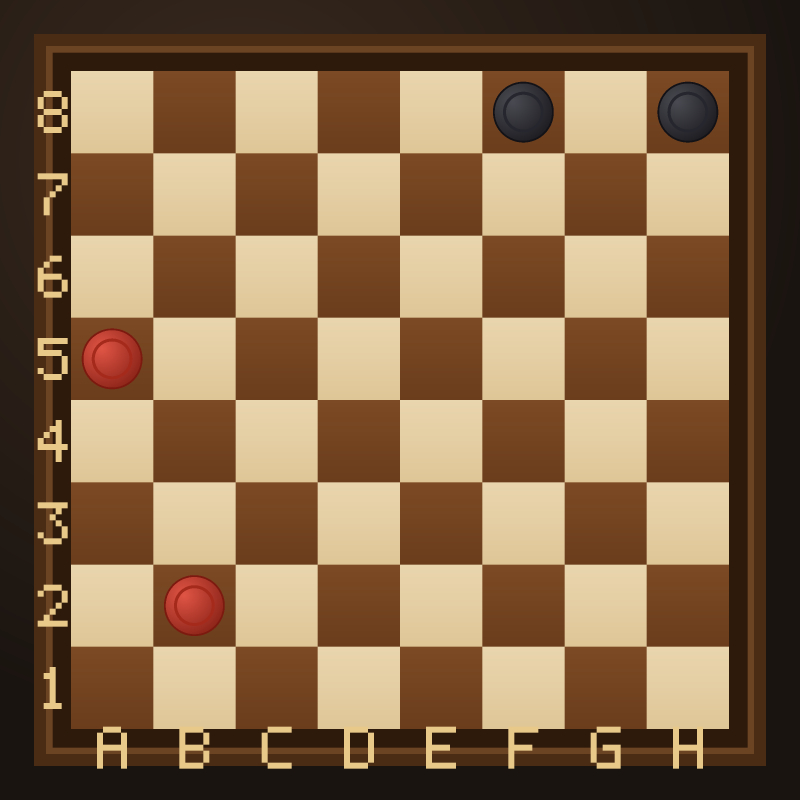
Below is the hardest three-piece ending in that table: two men against a lone king, with Red to
move. Every move you will see is optimal for whoever is to play — Red wins as fast as the
position allows, Black survives as long as it can — so what runs is not a suggested line but
the game. It takes 31 moves.
The deepest three-piece win
Red wins in 31 moves — and in no fewer
Two men beat a king. The lone king is faster and stronger than either man,
and it still loses — but only if Red never once goes wrong across 31 moves. That is what
"solved" buys you: not an opinion about the position, a number.
Endgame tables are built backwards from the finished positions, so every piece you add multiplies
the work. Our own four-piece table makes the shape of that growth visible, because it is small
enough to describe completely:
Pieces on the board
Positions (Red to move)
Drawn
Longest forced win
2
3,488
67.9 %
7 moves
3
196,032
4.3 %
31 moves
4
6,209,316
27.7 %
55 moves
Two things jump out. The count multiplies by roughly thirty with each added piece, and the
longest win gets dramatically longer — a 55-move forced win exists with just four pieces left on
the board. Carry both trends out to ten pieces and you arrive at Chinook's 39 trillion entries
and at the reason no one has gone further. The deepest win in our table is this one:
Two men against two men, Red to move. The table says Red wins in exactly 55 moves — 109
half-moves of play in which neither side may err. No search running against a clock finds
this; it is a lookup.
Watch it play out on the endgame database page.
Which draughts games are solved
"Checkers is solved" is a statement about one game among many, and the differences are larger
than they look. Rules change the game even when the board does not.
Brazilian draughts is the instructive case. It uses the same 8×8 board and the same starting
position as American checkers, so it is tempting to assume the 2007 result covers it. It does
not. Brazilian kings fly any distance along a diagonal, men capture backwards, and the longest
available capture is compulsory — three changes that rewrite the endgame completely. Chinook's
databases and our four-piece table are both American-only for exactly this reason, and the
engine on this site refuses to consult them in any other variant.
International draughts is further away still. Its state space is estimated at around
2.3 × 1033 positions — on the order of ten trillion times checkers —
and the 10×10 board with flying kings makes the endgame tables that much larger too. The useful
comparison is not "harder"; it is that the method which cracked 8×8 does not scale.
Checkers against chess
The question behind "is checkers solved" is very often really "so when does chess fall", and the
numbers answer it bluntly. Checkers has about 5 × 10²⁰ positions. Published estimates
for the number of legal chess positions run from roughly 1043 to 1050.
That is more than twenty orders of magnitude, and the gap is not the kind that better hardware
closes — twenty orders of magnitude is the difference between a thimble and every ocean on
Earth, several times over.
Chess endgame tablebases have reached seven pieces, and eight-piece work is under way; they are
the direct equivalent of Chinook's ten-piece databases, and they show the same wall. Nobody
expects chess to be solved. Checkers was solvable precisely because it is smaller, which is a
statement about the size of its tree and not about the difficulty of playing it well.
Does solving kill the game?
It would if anybody could play the solution, and nobody can. Three things keep the game alive.
The draw lives only on the correct path. The proof says that perfect play draws.
The moment either side plays something that is not perfect, the position has a different value,
and from then on the game is a contest again. Over the board every game is decided by mistakes,
and solving the game did not stop humans making them.
Knowing the result is not knowing the moves. The 55-move win in the diagram
above is a four-piece position — the simplest kind of ending there is — and it is beyond any
unaided human. A strategy for the full game is not something a person can carry.
Tournament checkers already assumed the draw. The three-move ballot was adopted
long before 2007, for the very reason the proof later confirmed: free play between strong players
draws too often to be interesting. The competitive game is built around the result, not refuted
by it. If you want to see how little of this matters at the board, our
checkers strategy guide deals in ideas humans can actually
use, and the daily puzzle is a position with one winning move
and a clock running in your head.
Common questions
Is checkers a solved game?
Yes, weakly. In 2007 the Chinook team at the University of Alberta published a proof that
American checkers, played perfectly by both sides from the standard opening position, is a draw.
Weakly solved means they produced a strategy that never loses from the start, for either colour.
It does not mean the result is known for every position that could ever appear on a board.
Has checkers been strongly solved?
No. Strongly solved means the exact result is known for every legal position, not just the
starting one, and that has only been done for part of checkers: every position with ten pieces or
fewer. That is a database of about 39 trillion positions. Everything between the opening and
those endings is covered by the proof only along the lines the proof had to settle, which is a
far smaller set than the whole game.
Who solved checkers, and when?
Jonathan Schaeffer and the Chinook group at the University of Alberta. The computation ran from
1989 to 2007 with a pause between 1997 and 2001, and the result appeared in Science on 14
September 2007 under the title Checkers Is Solved, after first being published online that July.
Does a solved game mean the computer always wins?
No, and this is the most common misreading. A perfect player cannot be beaten, but against
another perfect player it draws, because a draw is the game's true result. Against a human it
wins only when the human makes a mistake. What solving removes is the possibility of beating
perfect play, not the possibility of drawing with it.
Is international draughts solved?
No. International draughts is played on a 10x10 board with flying kings and compulsory maximum
capture, and its state space is estimated at roughly 2.3 x 10^33 positions — around ten trillion
times larger than 8x8 checkers. Nothing close to a solution exists, and the 2007 checkers proof
does not transfer, because different rules make a different game even on the same board.
Is checkers harder than chess?
Not by the measure that decides whether a game can be solved. Checkers has roughly 5 x 10^20
possible positions; estimates for chess run from about 10^43 to 10^50. That is more than twenty
orders of magnitude apart, which is why checkers fell in 2007 and chess has not been solved and
will not be soon. Harder to play well is a different question, and there the gap is far smaller
than the numbers suggest.
How many positions are there in checkers?
About 5 x 10^20, usually written as 500 billion billion. The exact total depends on what you
count: raw placements of pieces on the 32 dark squares give a larger figure than positions that
can actually be reached from the start, and published counts differ for that reason. The proof
itself never had to visit them all — roughly 10^14 positions were enough.
Can I play against perfect play?
In the endgame, yes. Every position with four pieces or fewer is solved exactly on this site, and
on the hard level the engine looks the answer up instead of searching, so once the board is down
to four pieces it plays perfectly and will convert any win that exists. Earlier in the game it
searches, like any other engine, and can be beaten.
Sources
Jonathan Schaeffer, Neil Burch, Yngvi Björnsson, Akihiro Kishimoto, Martin Müller, Robert Lake,
Paul Lu and Steve Sutphen, Checkers Is Solved, Science317
(5844), 1518–1522, 14 September 2007. Jan-Jaap van Horssen, Complexity of checkers and
draughts on different board sizes, ICGA Journal, 2019
(doi: 10.3233/ICG-190077). The four-piece figures and the two positions on this page come
from our own table, which is published as an
open dataset so that anyone can re-derive them.
See the solved part for yourself
The checkers endgame database holds all 6.4 million solved
positions with the classic endings laid out to play through, the
analysis board will tell you whether any position you build is
won, lost or drawn, and on the hard level the game itself stops searching and starts looking up
once four pieces are left. Free, no signup.