Checkers for Kids
Six rules, the two that cause arguments, and a board on this page · Updated November 15, 2026
Checkers is one of the few real games a five or six year old can learn in an afternoon and then keep for life. The rules fit in six lines. Two of them cause every argument at the board, and most pages written for children quietly leave one of those two out — which is why the first proper game ends in a row. Both are explained here, with a diagram each, and there is a board further down this page set to the easiest level so a child can play straight away, with nothing to download and no account to make.
The whole game in six rules
This is the full set. Nothing has been simplified away, because a rule left out now is an argument later — and children are very good at noticing that the grown-up changed the game when it started to go badly.
- Only the dark squares are used. The board has 64 squares and the game only ever touches 32 of them. Every piece starts on a dark square and stays on dark squares all game.
- Red moves first. Each side starts with twelve pieces on the three rows nearest them.
- A plain piece moves one square diagonally forward. Never sideways, never straight ahead, never backwards.
- To capture, hop over and land behind. If an enemy piece sits on the next diagonal square and the square straight behind it is empty, you jump over it, land there, and take that piece off the board. If the piece you landed with can jump again, it must — all in the same turn.
- If you can jump, you must. No quiet move is allowed while a capture is on the board. If several jumps are available you pick whichever you like.
- Reach the far row and you get a crown. A crowned piece — a king — may move and jump backwards as well as forwards. You win when the other side has no pieces left, or still has pieces but no legal move at all.
That is the entire game. For the long version, with the tournament wording and the draw rules, there is the full guide to how to play checkers.
Which way the pieces go
The first thing almost every child does is move a piece backwards to save it. They cannot. A plain piece has exactly two possible moves — forward-left and forward-right — and in the middle of an empty board that is all it will ever have. A king, by contrast, has four.
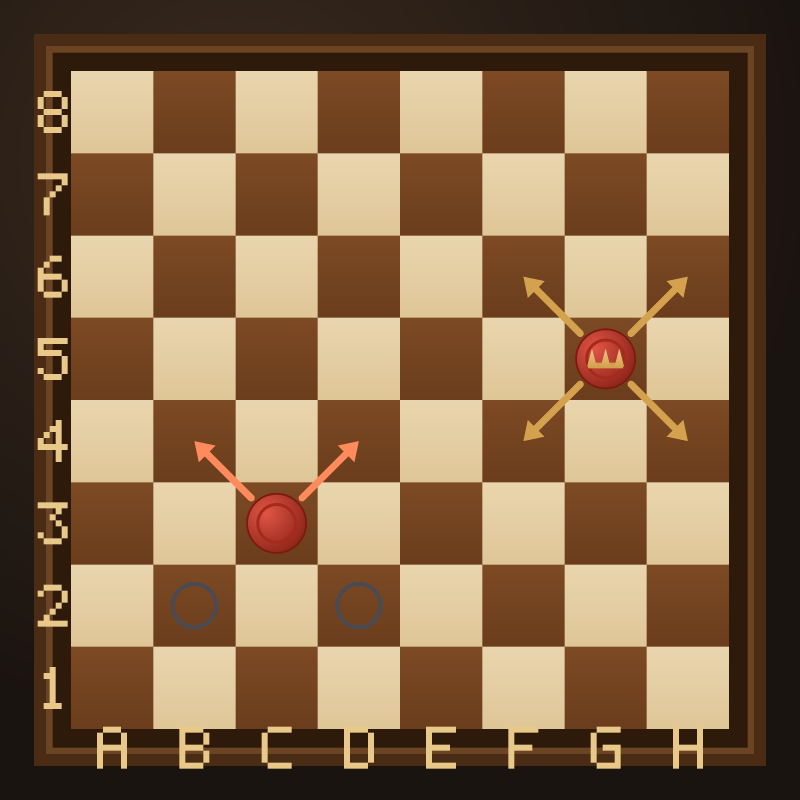
This is worth saying out loud to a child once, with a finger on the board, and then never again: they will absorb it in about three moves. The useful consequence to add is that a piece on the very edge of the board has only one move instead of two, which is the first real piece of checkers strategy anybody learns.
Why jumping is not optional
Here is the rule that causes the row. If one of your pieces can jump, you are not allowed to do anything else — not even when the jump is obviously bad for you. Children find this outrageous, and they are right that it feels unfair. It is also the rule that turns checkers from a race into a game, because it means a piece can be offered: give one away, force the capture, and take two back.
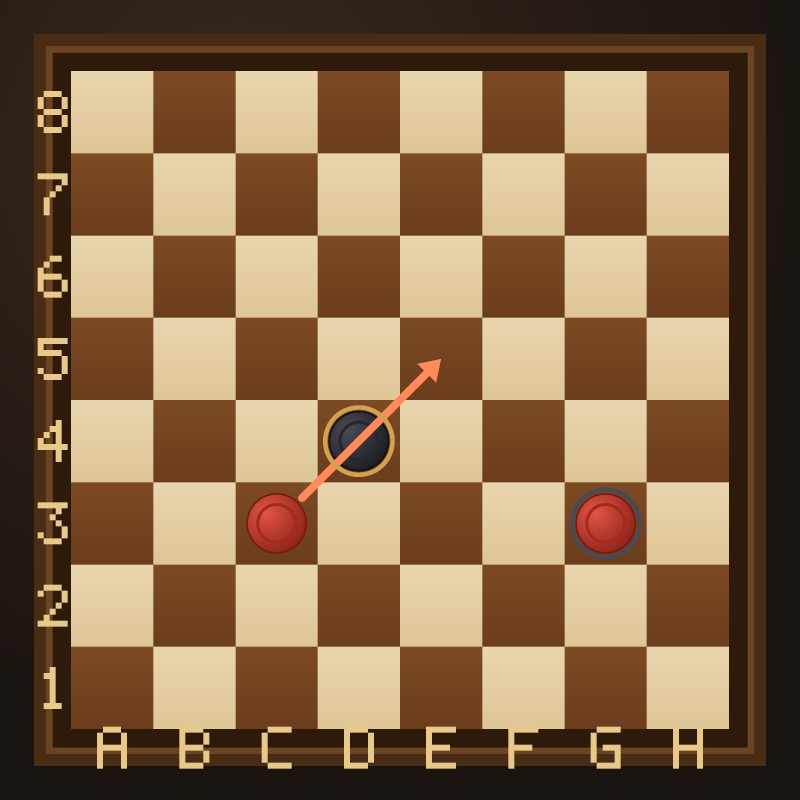
Two details that save arguments later. A jump can chain: if the piece that just landed can jump again, it keeps going, and that still counts as one turn. And a piece that reaches the far row by jumping gets its crown and stops there — it does not continue as a king in the same turn. Both of those are exactly how the board on this page plays, because the page and the board read the same rules.
What age can a child start?
Nearly every checkers set on a shop shelf says 6+. Pressman, Continuum Games and Winning Moves all print it; a few simplified children's sets say 5, and Chinese checkers — a different game on a star-shaped board — is usually marked 8.
But an age on a box is a guess about an average child, and you have a specific one. The honest test is what the game actually demands, and it is short:
- Can they see a diagonal? Not name it — see it. Point at a square and ask which squares touch it at the corners.
- Can they count to eight without losing track? That is the length of the board, and it is the whole of the arithmetic.
- Can they accept that a move is finished? This is the one that decides it, and it has nothing to do with the game.
A four year old who passes those three can play checkers, usually with the compulsory jump switched off for the first week. A six year old who fails the third will have a miserable time, and the answer there is a few more weeks, not a different game.
Teaching it in four short sittings
Not one long explanation. The game has four separate ideas in it, and a child can hold one new idea at a time comfortably and two with effort.
- Setting up and moving. No capturing at all. Race your pieces to the far side. Ten minutes.
- Jumping, but allowed rather than forced. Let them find jumps on their own. Point out yours before you take them.
- The compulsory jump, and a whole game. Expect the first complaint here; it is the right moment to show them the trick of offering a piece on purpose.
- Crowns. Leave this last. A king is a reward, and rewards land better when the rest already works.
Stop while they still want another game. That single habit is worth more than any explanation on this page.
Play right here
The board below is the real game, set to its easiest level, and it runs entirely in this browser tab. No app, no account, no download. On this level the computer looks only two moves ahead and deliberately plays a weaker move about a third of the time — on purpose: a child who never wins stops playing, and the first win is the whole point.
Checkers against the computer
Level
Board
Your turn — you are red.
Open the full game — a harder level, two players on one screen, and a private link you can send to a friend or a grandparent.
How often does anyone actually beat it? Across 4,306 games of standard checkers played against the computer on this site, people have won 1,866 — about 43 in every 100, with another 511 drawn. That count mixes all three levels together, because the site records the result and not the setting, so take it as what it is: evidence that the computer here is beatable, not a per-level figure. If the easy level ever stops being a contest, the next one up is one button away, and the levels are described in detail with the numbers behind them.
Four mistakes children make
None of these are signs of a child who will not take to the game. All four are near enough universal, and all four are easier to name once than to correct repeatedly.
- Pushing every piece forward at once. The front row empties, the back row never moves, and the crowns arrive from the other direction. The fix is a single sentence: the pieces on your own back row are a wall, and a wall that stays put cannot be crowned over.
- Taking every jump on offer. Once the compulsory rule lands, children start treating captures as points. The counter-question is the whole of checkers: after you take that one, what can they take?
- Hiding pieces on the edge. The edge looks safe because nothing can jump them there — and it is, but an edge piece has one move instead of two, so half the army ends up doing nothing.
- Giving up when a piece is lost. Being one piece down is not losing. The daily puzzle is a good antidote: every one of them is a position where a short forced sequence wins material back.
Questions parents ask
At what age can a child learn to play checkers?
Most checkers sets are sold as six and up — Pressman, Continuum Games and Winning Moves all print that on the box, and a few simplified children's sets go to five. But the age on a box is a guess about an average child, not a rule. What the game really asks for is small and testable: can the child tell a diagonal from a straight line, count to eight, and accept that a move cannot be taken back? A four year old who can do those three things can play. A six year old who cannot will be frustrated, and the fix is a few weeks, not a different game.
Can a 4 year old play checkers?
Often yes, with one change: drop the compulsory jump for the first few games. Everything else in checkers is within reach of a four year old — pieces move one square diagonally forward, you jump over the other colour, you get a crown at the far end. The rule that defeats them is the one that forces a capture they can see is bad for them, because it feels like being punished for noticing. Add it once the rest is automatic.
What are the simple rules of checkers for kids?
Six of them. Pieces live only on the dark squares, so only 32 of the 64 squares are ever used. Red moves first. A plain piece moves one square diagonally forward. To capture, you hop over a neighbouring enemy piece onto the empty square straight behind it, and you take it off the board. If a jump is available you have to take it. A piece that reaches the far row gets a crown and may then move and jump backwards as well. You win when the other side has no pieces left, or has pieces but no legal move.
Do you have to jump in checkers?
Yes, in standard checkers, and this is the rule children argue about most. If any of your pieces can jump, you must jump — you cannot make a quiet move instead. If more than one jump is available you may choose which, and if the piece that just landed can jump again it must keep going in the same turn. The rule is what makes the game tactical rather than a race, because it means a piece can be offered deliberately.
How do you teach a child to play checkers?
In four short sittings rather than one long one. First sitting: setting up, and moving only — no captures at all, just get to the other end. Second: add jumping, still without forcing it. Third: add the compulsory jump, and play a whole game. Fourth: crowns. Ten minutes each is plenty, and stopping while the child still wants more is the point. A game lost badly on day one costs more attention than any explanation buys back.
Is checkers good for children?
It asks for exactly the things that are hard to practise deliberately: looking one step ahead, accepting a consequence, and losing without the game ending in tears because the next one starts in ten seconds. It is also short. A full game between beginners takes a few minutes, which matters more at six years old than any claim about brain training — a game that outlasts the attention span teaches nothing.
Can my child play checkers against the computer for free?
Yes, on this page. There is a board above set to the easiest level, with no sign-up, no download and no app. On that level the engine looks only two moves ahead and deliberately plays a weaker move about a third of the time, which is the point: a child who never wins stops playing. Across 4,306 games of standard checkers on this site people have beaten the computer 1,866 times.
How long does a game of checkers take?
Between beginners, usually five to ten minutes. The board starts with twelve pieces a side and every capture makes it shorter, so games speed up as they go. There is also a stop built in: if forty half-moves pass with no capture and no plain piece moving forward, the game is a draw, which prevents two kings chasing each other around an empty board for ever.
Where to go next
When the six rules are automatic, the next thing that helps is not more rules but a reason to come back. The daily puzzle is one position a day with a short forced win in it, playable without an account. For the complete rules in tournament wording there is the full rules page, and when a child wants to beat a person instead of a computer, a private link opens the same board in two browsers.